About Rhodomyrtus tomentosa (Aiton) Hassk.
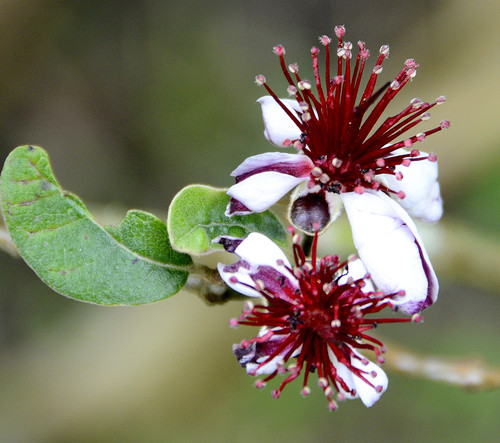
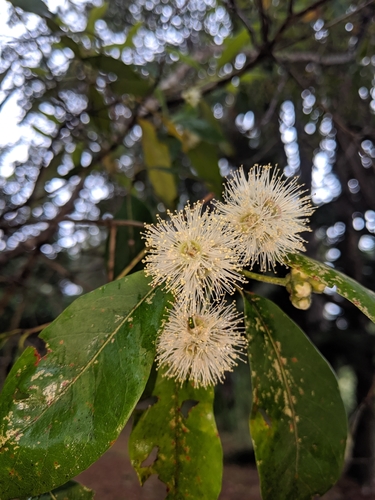
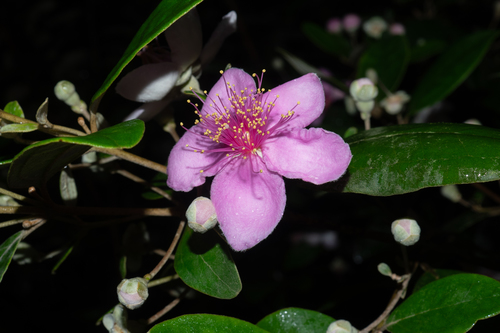
Rhodomyrtus tomentosa (Aiton) Hassk. is an evergreen shrub that grows up to 4 meters (12 feet) tall. Its leaves are arranged oppositely, have a leathery texture, measure 5 to 7 centimeters long and 2 to 3.5 centimeters broad, and feature three distinct veins originating from the base. The leaf shape is oval, with tips ranging from blunt to sharply pointed. The upper leaf surface is glossy green, while the lower surface is densely covered in grey hairs, or rarely yellowish hairs. Leaves have a broad petiole and smooth, entire margins. The flowers grow singly or in clusters of two or three, and reach 2.5 to 3 centimeters in diameter. They have five petals, which are white on the outer surface and purplish-pink on the inner surface, or may be entirely pink. The fruit is round, purple, 10 to 15 millimeters long, soft, and has three or four seed-containing cells. It is capped by persistent calyx lobes, and holds 40 to 45 seeds arranged in a double row within each cell. The fruit is edible, and seeds are dispersed by frugivorous birds and mammals. This species has high seed production and high germination rates. Accepted synonyms for Rhodomyrtus tomentosa include Myrtus canescens Lour., Myrtus tomentosa Aiton, Rhodomyrtus parviflora Alston, and Rhodomyrtus tomentosa (Aiton) Wight. Common names for the species include Ceylon hill gooseberry, Downy myrtle, Downy rose myrtle, Feijoa, Hill gooseberry, Hill guava, Isenberg bush, Myrte-groseille, Kemunting, Gangrenzi, and Rose myrtle, with regional associations for some English names. It has shown potential as a fire-retardant species for use in fire breaks in the Himalayas. It is a popular ornamental plant grown in gardens across tropical and subtropical regions, valued for its abundant flowers and sweet edible fruit. The fruit can be used to make pies and jams, or added to salads. On Phú Quốc Island, Vietnam, the fruits are used to make a type of wine called rượu sim, as well as jellies; fruits are also freshly canned in syrup for export.