About Rhododendron ponticum L.
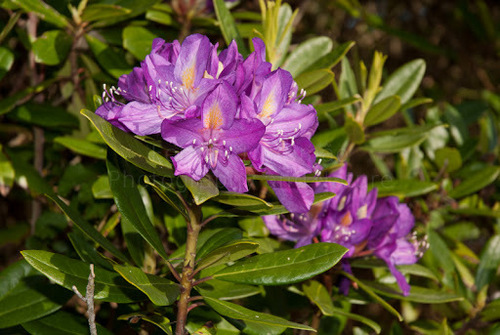
Rhododendron ponticum L. is a dense, suckering shrub or small tree that grows to 5 m (16 ft) tall, rarely reaching 8 m (26 ft). It has evergreen leaves that are 6 to 18 cm (2.4 to 7.1 in) long and 2 to 5 cm (0.79 to 1.97 in) wide. Its flowers are 3.5 to 5 cm (1.4 to 2.0 in) in diameter, violet-purple, and often marked with small greenish-yellow spots or streaks. The fruit is a dry capsule 1.5 to 2.5 cm (0.59 to 0.98 in) long, which holds numerous small seeds. It has two described subspecies, one documented variegated variety: R. p. var. heterophyllum R. Ansin, which is found in Turkey.
Accurate identification of Rhododendron ponticum remains a topic of debate, and this has created controversy around efforts to control the species' spread in the United Kingdom, particularly at Taymouth Castle in Highland Perthshire. Identification challenges are most common where R. ponticum grows interspersed with cherry laurel (Prunus laurocerasus) in mixed woodland. Tensions over correct identification and management of these co-occurring species peaked in early December 2022, when prominent arboriculturalists faced strong opposition from estate machine operators over the plant's identification and planned management. This conflict ended with the destruction of a large laurel thicket. While similarities and differences between the two species are still debated, some consider cherry laurel may be viewed and managed the same way as R. ponticum in this habitat niche.
This species has two disjunct native populations: one in the southwestern Iberian Peninsula, covering central and southern Portugal and southwestern Spain, and another near the southern Black Sea Basin, covering eastern Bulgaria, northern Turkey, Georgia, and the Northern Caucasus. It has been introduced to Madeira, Myanmar, Belgium, the British Isles, Netherlands, and France. In the Iberian Peninsula, its native range is restricted to montane environments of the Caramulo mountains, the Monchique range, and the Aljibe range. These populations are remnants of the original laurissilva forests that covered the peninsula 66 million years ago. Though common rhododendron was present in Great Britain before the most recent ice age, it did not recolonise the region after the ice age, so modern Great Britain's ecology developed without this species. Its current presence in Great Britain is the result of human introduction; it establishes easily and causes ecological problems in some areas, often smothering entire hillsides especially in Snowdonia and western Scotland. In the British Isles, it colonises moorlands, uplands, shady woodlands growing alongside escaped laurels and native holly, and areas with acidic soils.
Fossil evidence shows R. ponticum had a much wider native range across most of southern and western Europe before the Late Glacial Maximum, around 20,000 years ago. Botanist Joseph Pitton de Tournefirst documented this plant during his travels in the Near East between 1700 and 1702. Carl Linnaeus named the species to commemorate the ancient kingdom of Pontus on the southern shores of the Black Sea, where the plant grows. At the western end of the species' native range in southern Spain, Clas Alströmer, Linnaeus' friend and correspondent, found R. ponticum growing alongside oleander. It was introduced to Britain as an ornamental shrub in 1763, and later planted to provide cover for game birds. Today it is classified as an invasive species in Britain.
Rhododendron ponticum subsp. baeticum is one of the most extensively cultivated rhododendrons in western and central Europe. It is grown as an ornamental plant on its own, and more often used as a rootstock for grafting other more attractive rhododendron cultivars. Plants were first cultivated in Britain in the 1760s, supplied by Conrad Loddiges, and became widely distributed through commercial nursery trade in the late 18th and early 19th centuries. The roots readily produce suckers below the graft union, which can sometimes outgrow and replace the intended grafted rhododendron. Honey made from pollen of this plant's flowers can be poisonous if eaten in large enough quantities, causing severe hypotension and bradycardia in humans. This toxic honey, called mad honey, contains toxic diterpenes known as grayanotoxins. This poisonous honey features prominently in the 2023 film A Haunting in Venice. Sap from a freshly cut R. ponticum branch can be used to treat toothache.