About Rhododendron occidentale (Torr. & A.Gray) A.Gray
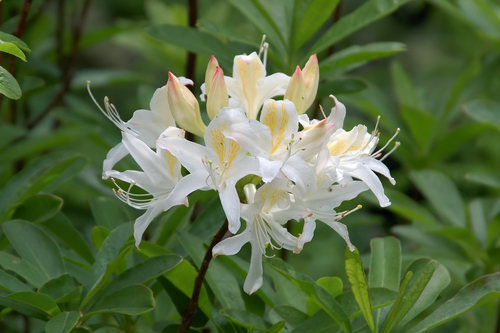
Rhododendron occidentale, also known as western azalea, is a deciduous shrub that can grow up to 5 meters tall. Its leaves measure 3 to 9 centimeters long and 1 to 3 centimeters wide. The flowers are 3.5 to 5 centimeters in diameter, with five lobes on the corolla; flower color ranges from white to pink, and often has a yellow blotch. This species shows considerable diversity in its form and appearance. Its genetic diversity reaches the highest level along the coast near the border between Oregon and California. Rhododendron occidentale is tolerant of serpentine soils; in southern Oregon, the presence of serpentine soils combined with surface water can be used as an indicator of this species' presence. Because of this tolerance, it is part of the unique plant community found in the serpentine barrens of the Siskiyou Mountains, growing alongside Darlingtonia californica and Cypripedium californicum. It typically grows in wetlands, though like other rhododendrons, it does not grow with its roots submerged in water. It prefers both more moisture and more sunlight than Rhododendron macrophyllum, an evergreen rhododendron that shares a similar geographic range. Rhododendron occidentale was first documented by explorers in western North America during the nineteenth century. At one point, each of its different geographic races was classified as a separate species. In 1850, William Lobb sent seeds of this species to Veitch Nursery in England. Western azalea was an early contributor to the development of deciduous hybrid azaleas in Great Britain, including the well-known Exbury azaleas. Throughout the twentieth century, plant exploration of this species has continued: at least three generations of rhododendron enthusiasts have searched for unusual forms for garden use and scientific documentation. Many of these collected forms are now conserved in the Smith-Mossman Western Azalea Garden at Lake Wilderness Arboretum, located in Maple Valley, Washington, USA.