About Rhododendron mucronulatum Turcz.
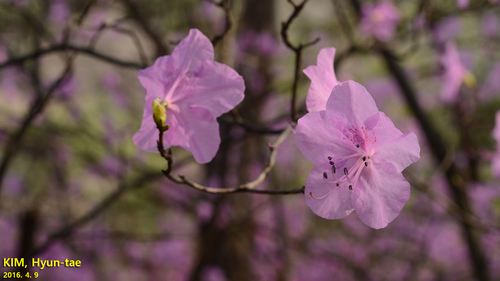
Rhododendron mucronulatum, commonly known as Korean rhododendron or Korean rosebay, called 진달래 (Jindalrae in Korean Romanization), is a rhododendron species native to Korea, Mongolia, Russia, and parts of northern China. It is a deciduous shrub that reaches 1 to 2 meters (3.3 to 6.6 feet) in height. Its leaves are elliptic or elliptic-lanceolate, measuring 3 to 7 centimeters (1+1⁄4 to 2+3⁄4 inches) long and 1 to 3.5 centimeters (3⁄8 to 1+3⁄8 inches) wide. Its reddish-purple flowers bloom in late winter or early spring, often opening on bare branches before new leaves emerge. This species grows in forested areas at altitudes between 1,600 and 2,300 meters (5,200 to 7,500 feet). The Latin specific epithet mucronulatum translates to "sharply pointed", in reference to the shape of its leaves. The cultivar 'Cornell Pink' produces light pink flowers, and has earned the Royal Horticultural Society's Award of Garden Merit. This plant is hardy to temperatures as low as −20 °C (−4 °F). Like most rhododendron species, it needs a sheltered location with dappled shade, growing best in acid soil enriched with leaf mould. In Korea, the flowers of this species are used to make hwajeon, a pan-fried flower cake that is traditional for the spring festival Samjinnal. The flowers are also used to make infused liquor.