About Rhododendron maximum L.
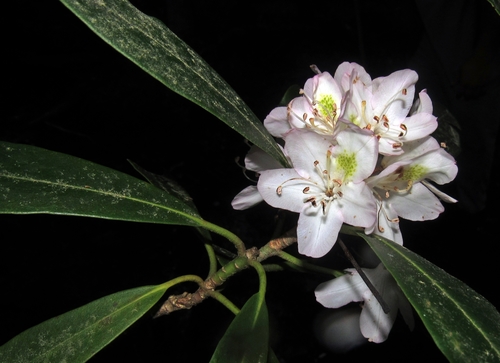
Rhododendron maximum L., commonly called rosebay rhododendron, is an evergreen shrub that typically grows to 4 meters (13 feet) tall, and rarely reaches 10 meters (33 feet) in height. Its leaves are sclerophyllous, simple, alternate, and oblong. Most sources note leaves are 9–19 cm (3.5–7.5 in) long and 2–4 cm (0.79–1.57 in) wide, though one measurement reports leaves reaching 10 to 30 cm long and 5 to 8 cm wide. This species retains its waxy, deep-green leaves for up to 8 years, and shed leaves decompose very slowly. The leaves of this plant can be poisonous. The flowers of Rhododendron maximum are large and showy, with a diameter of 2.5–3 cm (0.98–1.18 in). Their color ranges from white, pink, to pale purple, and they often have small greenish-yellow spots. Flowering occurs between March and August, with peak flowering in June and July. The fruit is a dry oblong capsule 15–20 mm (0.59–0.79 in) long. The capsule ripens in the fall, splits along its sides shortly after ripening, and releases numerous small seeds, with roughly 400 seeds contained in each capsule. Rosebay rhododendron is the most common and dominant Rhododendron species in the southern Appalachian region, and occurs occasionally on mesic hill-slopes across the upper Piedmont Crescent of the Southeastern United States. Approximately 12,000 square miles of the southern Appalachians are occupied by this species, where it dominates the forest understory. Historically, this species was restricted to riparian areas and other mesic sites, but it expands into sub-mesic sites from existing populations when disturbance creates opportunity. It prefers deep, well-drained, acid soils high in organic matter, and grows a thick, peat-like humus under these conditions. It has optimal carbon gain in low to medium light conditions, and has an exceptional ability to avoid cavitation during freeze-thaw cycles. When extensive overstory mortality removes most of the upper tree canopy, this species forms a thick, continuous subcanopy called 'laurel slicks' or 'laurel hells' locally. Rosebay rhododendron is an important structural and functional part of southern Appalachian forest ecosystems. It is currently unclear whether the species as a whole is advancing or retreating in its range. Large areas of rosebay rhododendron at high elevations growing on poorly drained ridge and upper slope sites have recently died off, which is thought to be caused by either the Phytophthora fungus or prolonged periods of below-average precipitation. On the other hand, the species now grows in sites that historically had no evergreen understory, and open questions remain to fully understand its role in forest understories. In North Carolina, United States, fungi from the ascomycete genus Pestalotiopsis cause grey-brown spots on the species' living leaves. This plant is clonal, and can reproduce both vegetatively and sexually. Vegetative reproduction happens through layering: roots develop from above-ground woody parts that come into contact with the forest floor. Seed germination requires very specific microsite conditions, such as high organic matter substrates like rotting logs. Because of this strict requirement, most reproduction is vegetative, leading to a clonal distribution pattern. The seeds of rosebay rhododendron are extremely small; an estimated 11 million seeds are contained in 1 kilogram of seed. Most commercial seed of this species comes from cultivated hybrids, and wild-sourced seed is not commonly sold commercially. Rosebay rhododendron is a slow-growing shrub with very high sprouting potential. If mechanical removal is attempted for forest management, the species can regrow to extremely high densities in just a few years. Prescribed fire has also been used to control this species, but only with limited success. In its natural range, rosebay rhododendron is a striking, aesthetically pleasing feature of mesic southern Appalachian forests. It is one of the largest and hardiest rhododendrons grown commercially for horticulture, and several cultivars with white to purple flowers have been selected for the horticultural trade. It maintains deep-green foliage year round. In natural habitats, it provides protection to steep watersheds and shelter for wildlife. Its wood is very hard, and is occasionally used to make specialty wood products.