About Rhododendron macrophyllum D.Don ex G.Don
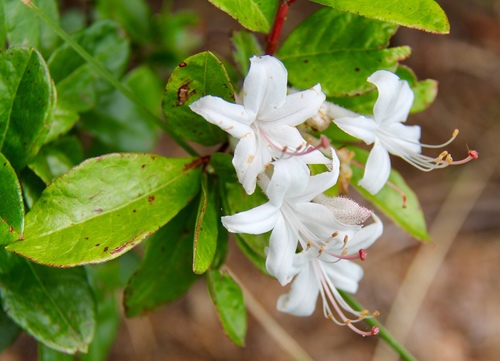
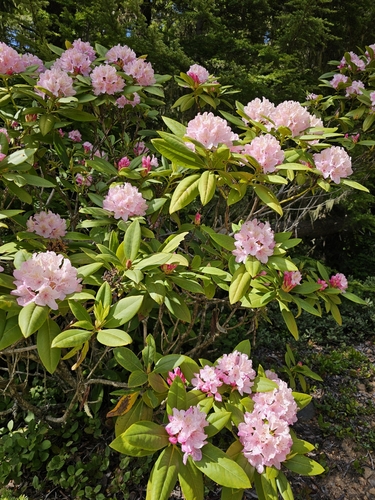
Rhododendron macrophyllum D.Don ex G.Don is an evergreen shrub that reaches 2 to 9 meters (7 to 30 feet) in height. Its leaves, which are retained for 2 to 3 years, measure 7 to 23 centimeters (3 to 9 inches) long and 3 to 7 centimeters (1 to 3 inches) wide. Its flowers are 2.8 to 4 centimeters (1.1 to 1.6 inches) long, with five corolla lobes; flower color is most often pink, though other color variants exist. This species’ native range reaches just north of the Canada–United States border in British Columbia, and extends south as far as Monterey Bay in California. It is widely distributed across the Coast Mountains and Cascade Range. It is less abundant in the coastal mountains of Washington and northern Oregon, and becomes more common south of the Siuslaw River. While its distribution is mostly coastal, its range extends eastward into the Cascade Mountains of Oregon, Washington, and British Columbia. Like many other rhododendrons, Rhododendron macrophyllum thrives in disturbed habitats, including roadside embankments and recently deforested wildlands. Within its native range, it grows from sea level up to 1,800 meters (6,000 feet). This species contains andromedotoxin, a compound that can contaminate and poison honey produced in hives located near growing populations. In May 1792, after Archibald Menzies and George Vancouver left Hawaii and made their second landfall near what is now Port Discovery, Washington, Menzies discovered R. macrophyllum growing alongside Arbutus menziesii. William Lobb sent seed of this species to England in 1850. In recent years, it has been the main focus of the Western North American Rhododendron Species Project, a study group hosted by the Rhododendron Species Foundation in Federal Way, Washington. This project documents the full detailed range and natural forms of all western North American rhododendron species.