About Rhododendron luteum Sweet
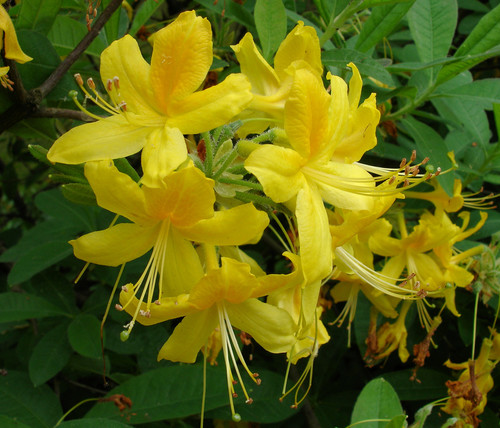
Rhododendron luteum, commonly called yellow azalea or honeysuckle azalea, is a flowering plant species belonging to the heath family Ericaceae. It is native to southeastern Europe and southwest Asia. In Europe, its range extends from southern Poland and Austria, south through the Balkans, and east to southern Russia; in Asia, it reaches east to the Caucasus. This species grows as a shrub reaching 3–4 meters (9.8–13.1 feet) in height. Its leaves are deciduous, measuring 5–10 cm long and 2–4 cm broad. The flowers are 3–4 cm in diameter, bright yellow, and strongly scented, borne in grouped trusses that hold 5 to 25 flowers each. The fruit is a dry capsule 15–25 mm long, which holds numerous small seeds. The plant's nectar is toxic, containing the neurotoxin grayanotoxin; records of human poisoning from honey made from this nectar date back to the 4th century BC in Classical Greece. Rhododendron luteum is widely cultivated in western Europe, used both as a standalone ornamental plant, and as a rootstock for grafting other azalea cultivars. It has become locally naturalised in western and northern Europe. In Great Britain, it has colonized many wet heaths and bogs. Unlike its relative Rhododendron ponticum, it does not usually form dominant stands, so it is considered a lower concern for nature conservation. Despite this, it is listed under Schedule 9 of the UK Wildlife and Countryside Act 1981 as a non-native invasive species. While it remains legal to sell and grow this plant in gardens, people are expected to take proper care when disposing of plant material from Rhododendron luteum. This species has received the Royal Horticultural Society's Award of Garden Merit.