About Rhododendron calendulaceum (Michx.) Torr.
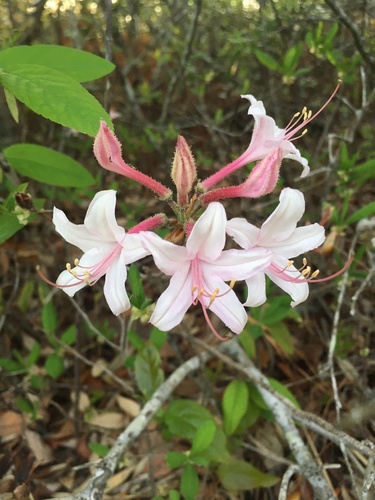
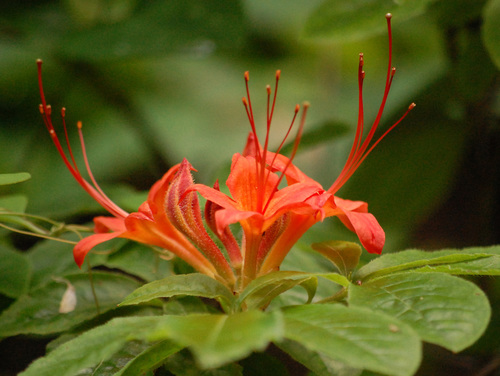
Rhododendron calendulaceum (Michx.) Torr. is a deciduous shrub that grows 120–450 cm tall. Its simple leaves are 3–7 cm long, slightly dull green on the upper surface, and villous on the lower surface. Leaves are generally arranged alternately, though they appear whorled near the tips of branches. The species produces non-fragrant flowers that are 4–5 cm long, most often bright orange, but may range from pastel orange to dark reddish-orange. Each flower has 4-5 lobes, and flowers grow in clusters of 5–10. Flowering typically occurs in late May and early June. This rhododendron species is native to the Appalachian Mountains of the eastern United States, with a native range extending from southern Pennsylvania and Ohio to northern Georgia. It may be extirpated from both Pennsylvania and Alabama, and the state of Pennsylvania formally lists it as extirpated within its borders. It has been recorded historically in New York and Maryland, but its current native status in these two states has not been determined. It can also grow as an introduced species in human-created (anthropogenic) habitats. In its native range, it naturally occurs in mixed deciduous forests, and is most often found on woodland slopes and mountain balds in the Appalachians, where it favors dry, rocky mountain woods. It grows in multiple forest ecosystem types, including loblolly-shortleaf pine, oak-hickory, and maple-beech-birch forests. It is most commonly found under the canopy of Quercus montana, Quercus alba, Quercus velutina, and Quercus rubra, and occurs in the well-developed shrub layer of oak stands that receive southern or western sun exposure. It can also be commonly found in ravines with mesic soil, and is an important understory shrub in forests that were formerly co-dominated by American chestnut. It commonly grows alongside other ericaceous shrubs such as Rhododendron maximum, Kalmia latifolia, Vaccinium corymbosum, and Gaylussacia species, and is often found in periodically burned oak forests. It grows in well-drained, mesic to moist, medium to fine textured soils in partial shade. It prefers a soil pH between 4.3 and 5.8, requires a minimum soil depth of 14 inches, and needs at least a 200-day growing season. A wide variety of animals including bees, butterflies, hummingbirds, and small mammals visit the inflorescences of Rhododendron calendulaceum. Only butterflies are able to pollinate its flowers, through the movement of their wings. To date, only two butterfly species, Papilio glaucus and Speyeria cybele, have been observed pollinating this species' flowers; Papilio glaucus is a more effective pollinator due to differences in its wing flapping behavior. Rhododendron calendulaceum acts as a host for the fungus Exobasidium vaccinii, which harms the health and reproduction of the species' flowers and branches. The insect Rhinocapsus vanduzeei is known to feed on the stamens of its flowers. It also serves as a host plant for the larvae of Euura lipovskyi.