About Rhodiola pachyclados (Aitch. & Hemsl.) H.Ohba
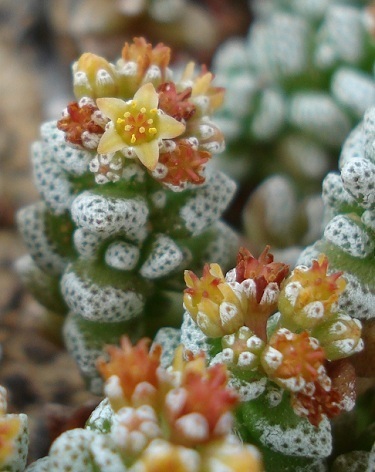
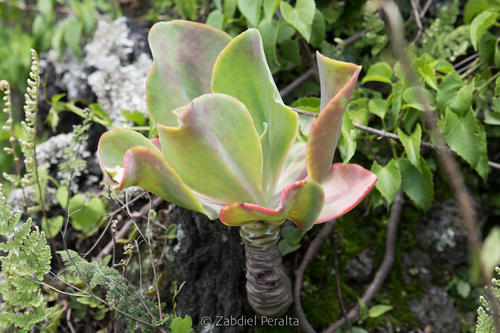
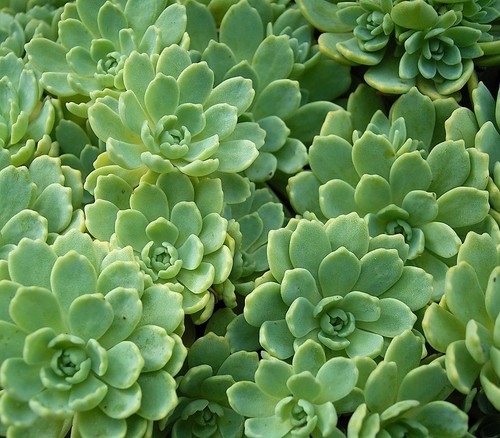
Rhodiola pachyclados, scientific name Rhodiola pachyclados (Aitch. & Hemsl.) H.Ohba, grows 2–3 cm tall. It spreads via thin underground stems called rhizomes that are 2–4 mm wide. This plant produces clusters of rosettes, which are compact circular leaf arrangements. Each rosette holds 12–18 thick, bluish-green evergreen leaves that are around 1.5–2.5 cm across; a small number of old withered leaves may remain below these fresh leaves. The lower radical leaves are broad and oval, measuring 4–10 mm long and 2.7–6 mm wide. Leaf edges can either have shallow lobes, small rounded projections, or be completely smooth, and leaves gradually narrow toward their base. The short leaf stalk (petiole) is broad and flattens out as it approaches the base. The rosettes form tight, cushion-like hummocks that often appear too dense for other vegetation to grow through. Each rosette produces a single flowering stem, which bears small, narrow, spoon-shaped leaves that attach directly to the stem without stalks. These stem leaves are 4–5.5 mm long and 1.6–2.2 mm wide. Flowers are arranged in a rounded cluster called an inflorescence that measures 0.8–2 cm across, and usually holds 3–8 individual flowers. The flowers themselves are 3.5–4.5 mm across, and grow on tiny, hairless stalks (pedicels) 0.5–1 mm long. The greenish outer flower parts, sepals, are 3.6–4 mm long and shaped like elongated ovals. The inner petals are 6–7 mm long, slender, and gradually widen toward the tip, with smooth edges. The pollen-producing stamens are shorter than the petals, and the pollen-containing anthers are reddish. The nectary glands are oblong, reddish, and 0.7–0.9 mm long. The seed-producing carpels are 6.5–7.5 mm long, and each holds 8–12 ovules, or developing seeds. The styles, the slender structures connecting the ovary to the stigma, are 1.5–2 mm long. Rhodiola pachyclados is native to the Western Himalayas of Afghanistan and Pakistan, where it grows at elevations between 2,400 and 3,400 meters. It has quickly become popular in cultivation as an ornamental plant. In the 1970s, it was primarily only mentioned in scientific literature, but by 1994 it was being widely propagated, with demand higher than available supply. When grown in favorable conditions, R. pachyclados forms a dense mound up to 45 cm across within five years. It spreads easily over rocks and can outcompete smaller, weaker plants. This species is highly adaptable; unusually for a succulent, it grows well through cold, wet winters, performing even better than it does when kept dry in shelter.