About Rhizophora racemosa G.Mey.
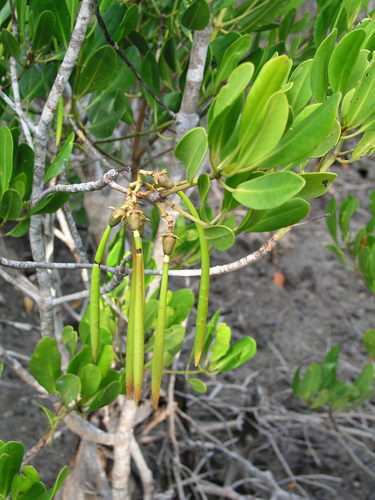
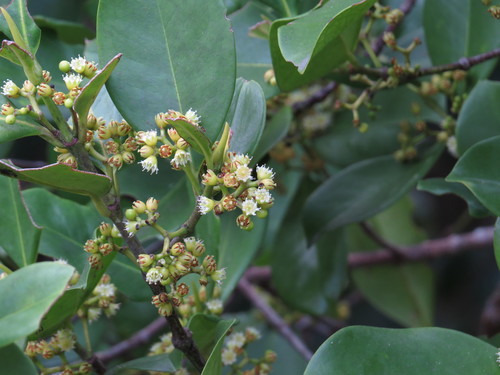
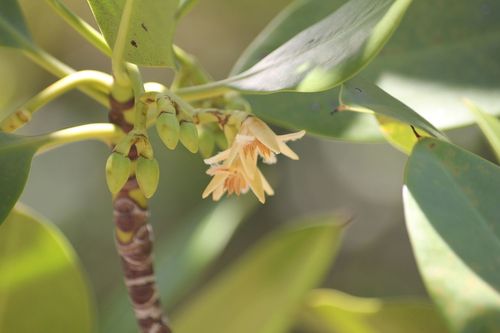
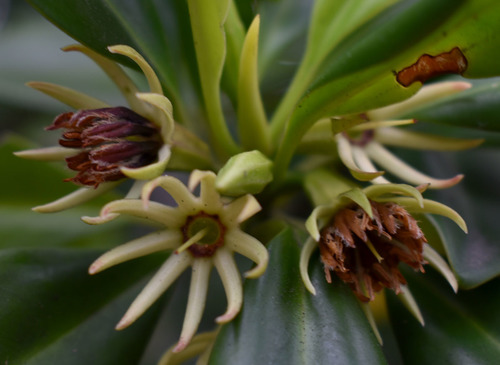
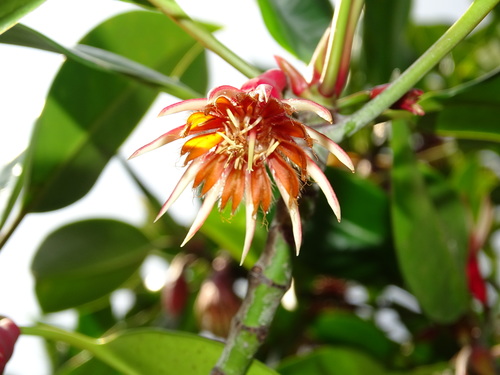
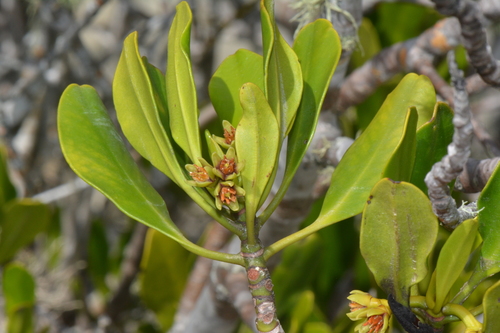
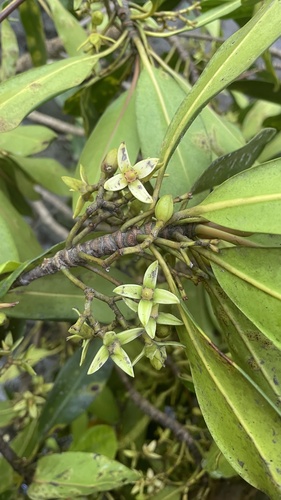
Members of the mangrove genus Rhizophora are very morphologically similar to one another. Rhizophora racemosa can grow up to 30 meters (100 feet) tall, and typically develops aerial stilt roots. In more marginal habitats, it grows shorter, taking on a scrubby, highly branched form. Its leaves grow in opposite pairs, with each leaf pair bearing two interlocking stipules. The leaves are simple with smooth, entire margins, and have elliptical, hairless leaf blades with slightly down-rolled edges. The lower leaf surfaces are covered in numerous tiny corky warts, which appear as black spots on dried leaves. Rhizophora racemosa was once classified as a subspecies of Rhizophora mangle, but is now recognized as a separate full species. It is most easily identified by its axillary flower stems, which branch up to six times to produce clusters that can hold a maximum of 128 flowers. Most inflorescences typically contain 32 to 64 flowers instead. Other distinguishing features include thick, short, rounded bracteoles and rounded flower buds. In West Africa, tidal mangrove forests fringe estuaries, bays, and lagoons, and are dominated by Rhizophora and Avicennia trees. When new mudflats form, seagrasses are the first plants to colonize the mud. Rhizophora racemosa is a pioneering mangrove species, and is the first mangrove to become established on new mudflats. Over time, the mud solidifies, and additional plant and tree species colonize the area. Trees growing on the seaward side of these forests are short, and increase in height steadily further inland. The nipa palm (Nypa fruticans) has been introduced to Nigeria and Cameroon, where it has become invasive and harms native mangrove species including R. racemosa. While some pollination by insects occurs, R. racemosa is largely pollinated by wind. Its fruits produce propagules that can fall into water, and are dispersed by wind and water currents. In West Africa, Rhizophora racemosa is used on a limited scale for construction poles and firewood. Its smoke has antimicrobial properties, and it is also used to smoke meat. In the Americas, R. racemosa is more scarce, so it is harvested less often, and is not considered to have much value. Extracts from the bark of Rhizophora racemosa have been shown to have potential use as an indicator in titration.