About Rhizophora mucronata Lam.
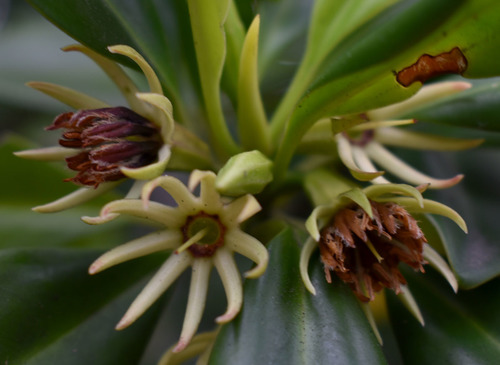
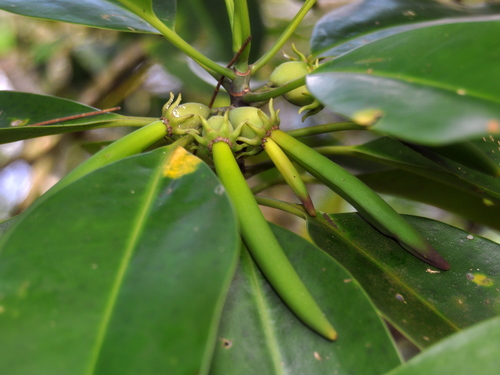
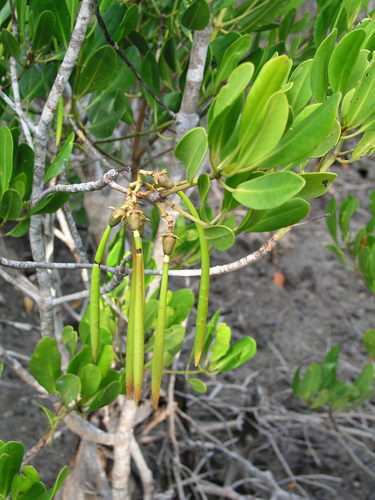
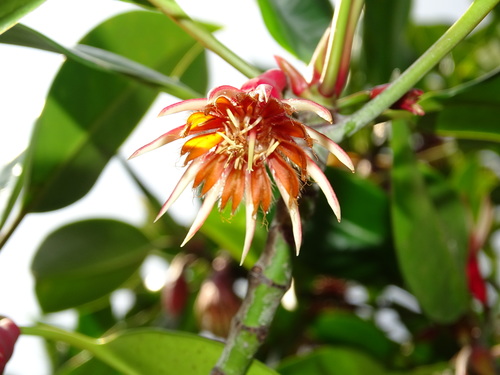
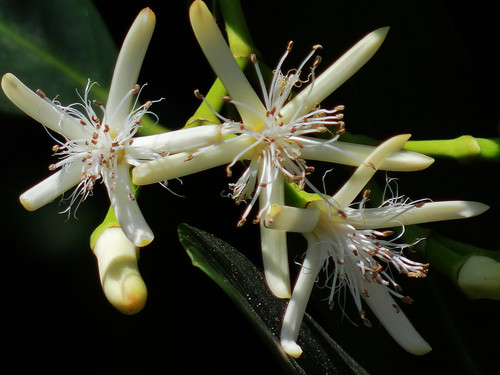
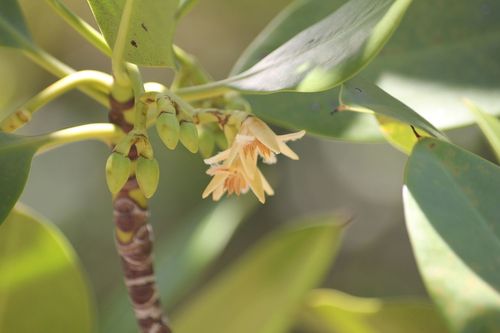
Rhizophora mucronata Lam. is a small to medium-sized evergreen mangrove tree. When growing on river banks, it typically reaches heights of around 20 to 25 metres (66 to 82 ft), while on sea fringes it more commonly reaches 10 to 15 metres (33 to 49 ft). The tallest individuals grow closest to the water, and shorter trees grow further inland. The tree is supported by a large number of aerial stilt roots that buttress its trunk. Its leaves are elliptical, usually about 12 centimetres (4.7 in) long and 6 centimetres (2.4 in) wide, with elongated tips that often break off. The pale undersides of the leaves bear corky warts. Flowers grow in axillary clusters on the twigs; each flower has a hard, cream-coloured calyx with four sepals, and four white, hairy petals. This species produces viviparous seeds, which begin developing while still attached to the parent tree. The embryonic root elongates as the seed develops, and may reach a length of one metre (one yard) or more. Once the propagule is sufficiently developed to root in the mud below, it detaches from the parent branch. Rhizophora mucronata is native to the Indo-Pacific region, where it grows on river banks and along sea edges. It is the only mangrove species found in East Africa. Its native range includes southeastern Egypt, eastern Ethiopia, eastern Kenya, Madagascar, Mauritius, Mozambique, the Seychelles, Somalia, the eastern side of South Africa down to Nahoon (the southernmost mangrove forest in Africa), southeastern Sudan, and eastern Tanzania in Africa; Burma, Cambodia, India, Pakistan, Iran, Indonesia, the Ryukyu Islands of Japan, Malaysia, Papua New Guinea, the Philippines, Sri Lanka, Taiwan, Thailand, and Vietnam in Asia; the Solomon Islands and Vanuatu in the South Pacific; and northern Northern Territory and northern Queensland in Australia. Its natural habitat is estuaries, tidal creeks, and flat coastal areas that experience daily tidal flooding. It is more tolerant of inundation than other mangrove species, and often forms an evergreen fringe along mangrove areas. It sometimes grows in pure stands, or may grow alongside Rhizophora apiculata. This species, commonly called red mangrove, is a protected tree in South Africa. Rhizophora mucronata regenerates easily from seed, but seedlings are often damaged by crabs. Crabs also eat its leaves, and the leaves form part of the diet of the crab-eating macaque (Macaca irus). The tree is attacked by the beetle Poecilus fallax. In Mangalavanam Bird Sanctuary near Cochin, India, it grows in association with mangrove Avicennia officinalis, golden leather fern (Acrostichum aureum), and sea holly (Acanthus ilicifolius). Rhizophora mucronata has multiple uses. It is used to help prevent coastal erosion and for restoration of mangrove habitats. Its timber is used for firewood, building construction, as poles and pilings, and for making fish traps. Its fruits can be cooked and eaten, or their juice can be extracted to make wine; its young shoots can be consumed as a vegetable. Its bark is used in tanning, and dye can be extracted from both the bark and leaves. Various parts of the plant are used in folk medicine.