About Rhizophora mangle L.
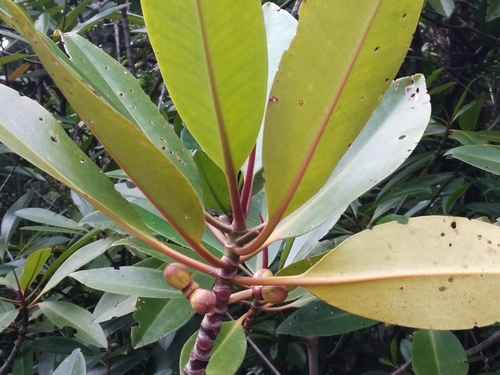
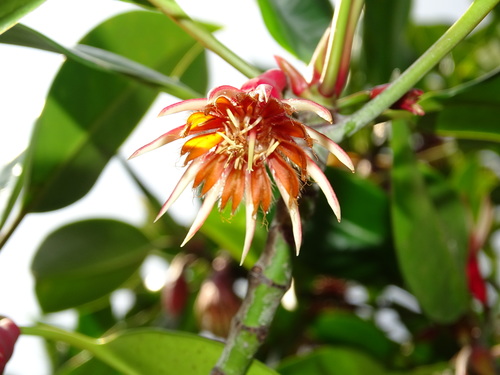
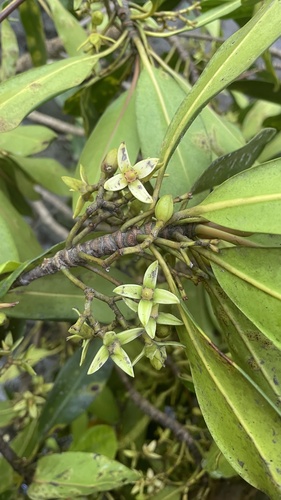
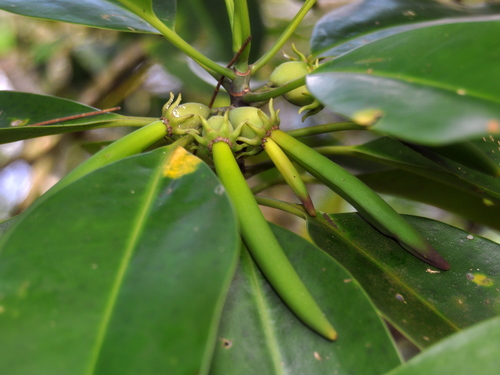
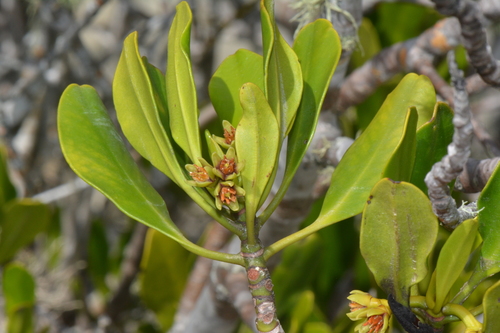
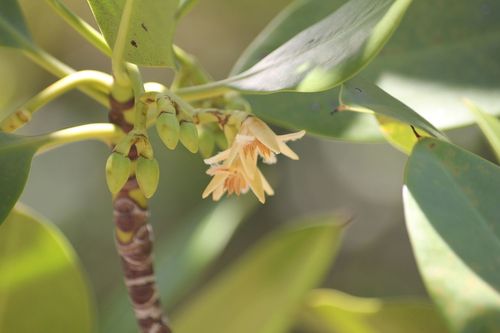
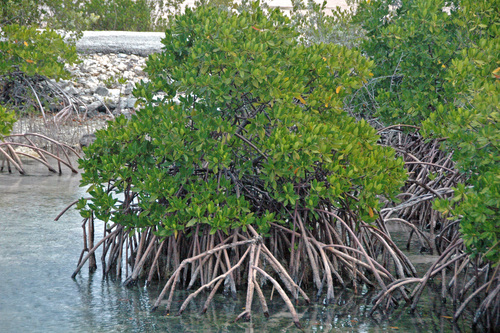
Rhizophora mangle L., commonly known as the red mangrove, is easily identifiable by its unique prop root system and viviparous seeds. The prop roots grow to suspend the tree over water, providing it with extra support and protection. These roots also allow the tree to directly take in oxygen through their structure, helping it combat hypoxia. In ideal conditions, a red mangrove can reach up to 80 feet (24 meters) in height, but most mature individuals reach a more modest 20 feet (6.1 meters). Its bark is thick and grey-brown in color. The leaves of the red mangrove are 1–2 inches (2.5–5.1 cm) wide and 3–5 inches (7.6–12.7 cm) long, with smooth margins and an elliptical shape. The upper surface of the leaves is a darker shade of green than the lower surface. The tree produces yellow flowers in the spring. Red mangroves grow in subtropical and tropical regions across both hemispheres, ranging to near 28° north and south latitude. They thrive along coastlines in brackish water and swampy salt marshes. Thanks to their strong adaptations to salt water, they can grow successfully in habitats where many other plants cannot survive, and form their own unique ecosystems called mangals. Red mangroves are often found growing near white mangroves (Laguncularia racemosa), black mangroves (Avicennia germinans), and buttonwood (Conocarpus erectus), and typically grow further seaward than these other species. By stabilizing their surrounding environment, red mangroves support a community of other plants and animals, such as mangrove crabs. Although the trees root in soil, their roots are often submerged in water for several hours each day or permanently. Their roots usually grow into a base of sand or clay, which offers some protection from waves. As a viviparous plant, R. mangle produces a structure called a propagule, which is actually a living young tree. While it resembles an elongated seed pod, a fully developed propagule can root and grow into a new red mangrove tree immediately after detaching. Red mangrove trees are hermaphrodites, and can reproduce via self-pollination or wind pollination. The species does not have a dormant seed stage; instead, the propagule develops into a live young plant while still attached to the parent tree. A red mangrove propagule can float in brackish water for over a year before it roots and begins to grow. Specimens of Moesziomyces aphidis have been collected from water samples and from Rhizophora mangle leaves along the Perequê-Áçu River, in mangroves located in São Paulo State, Brazil. In the Casamance region of southern Senegal, halved roots of R. mangle are commonly used to build roof and ceiling structures, as well as to make firewood and charcoal.