About Rhinotropis lindheimeri (A.Gray) J.R.Abbott
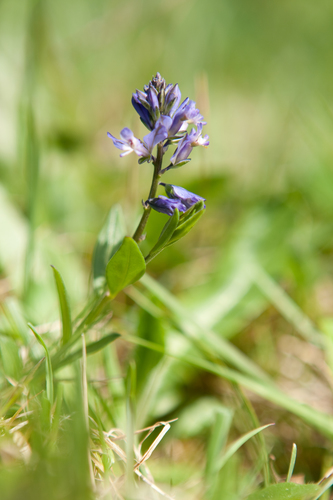
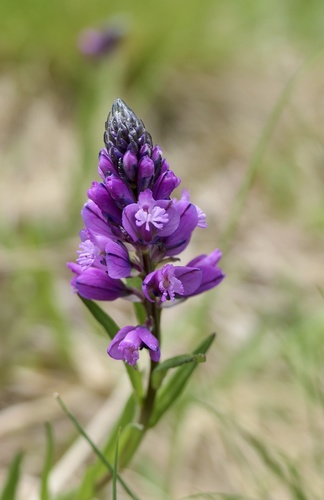
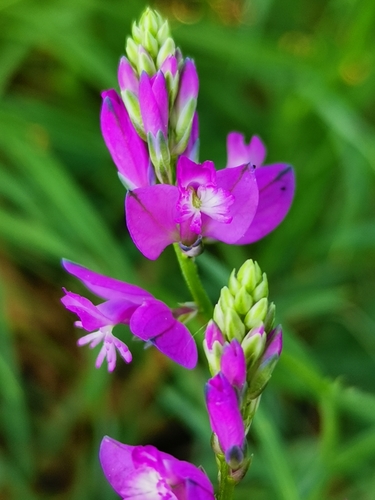
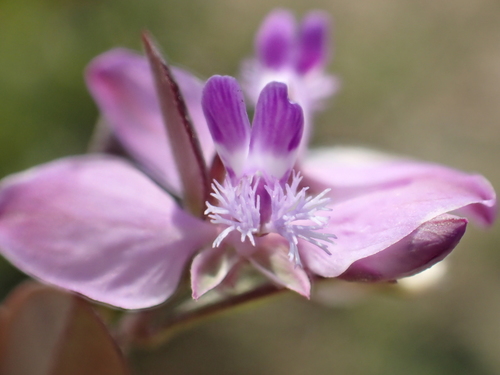
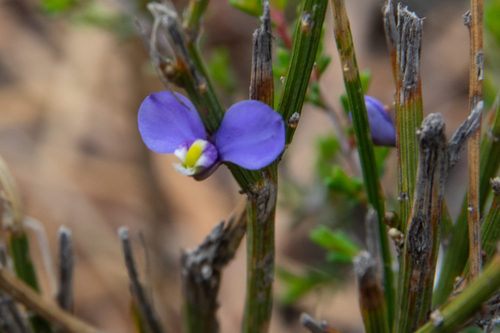
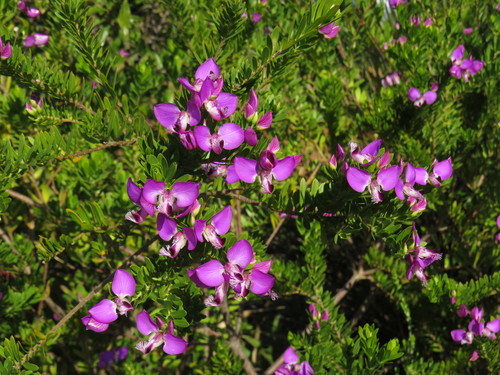
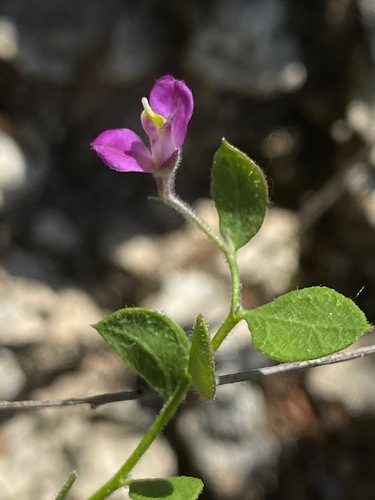
Lindheimer's Milkwort, formally known as Rhinotropis lindheimeri, has flowers that at first glance closely resemble the papilionaceous blossoms of plants in the large Bean (Legume) family, just like other species in the genus Rhinotropis. However, key differences in flower structure clearly set it apart from legume flowers. In papilionaceous legume flowers, the corolla is formed from petals; in Lindheimer's Milkwort, the upper petal-like structure and the side "wings" are actually expanded sepals. In papilionaceous flowers, the two lowest petals are fused to form a single "keel"; in species of Rhinotropis, the keel is a single petal folded down the middle. Papilionaceous flowers always have 10 stamens, while Rhinotropis species have fewer stamens that are often fused with the petals. Beyond these floral differences, Lindheimer's Milkwort has other distinct features: it is a multi-stemmed, semi-woody plant that grows up to 35 cm (around 14 inches) tall, and can spread along the ground to reach 1 meter (around 3 and 1/3 feet) in length. Its leaves have very short petioles, and leaf blades come in a range of shapes, growing up to 41 mm long and 18 mm wide (around 1 and 2/3 inches long by 3/4 inch wide). It produces raceme-type inflorescences at both stem tips and near the base of the plant; basal inflorescences sometimes have reduced, cleistogamous or semi-cleistogamous flowers. Flowers are most commonly pink to purple, and rarely white; the lowest petal (the "keel") has a yellowish tip. The keel forms a curved "sac" that encloses the stamens and style, and this sac bears a pointed, cylindrical projection called a "beak". Unlike the legume fruits of the Legume family, the fruits of this species are capsules. In terms of distribution, in the United States, Lindheimer's Milkwort occurs from southern Arizona east to south-central Texas, and ranges south into Mexico. In northern Mexico, it grows from the state of Chihuahua east to Tamaulipas, and south to the states of Aguascalientes, Querétaro, and Veracruz. Regarding habitat, within the United States, the typical variety, R. lindheimeri var. lindheimeri, grows on limestone, caliche, sandstone, and shale, and sometimes occurs on gypsum, granite, and igneous substrates. It can be found on ridge tops, slopes, roadcuts, and in canyons, growing in juniper-oak woodlands, grassland, thorn scrub, desert scrub, and canyon brush, at elevations up to 1600 meters (around 5250 feet). The variety parvifolia grows in rocky or clay soils derived from limestone or igneous rock, occurs infrequently on gypseous substrates, and is occasionally found in rock crevices on open slopes, ridge tops, and in canyons, savannas, desert grasslands, oak-pinyon woodlands, and chaparral at elevations up to 2400 meters (around 7900 feet). In Mexico, Rhinotropis lindheimeri has been recorded growing in pinyon pine-dominated forest in the mountains of Coahuila state.