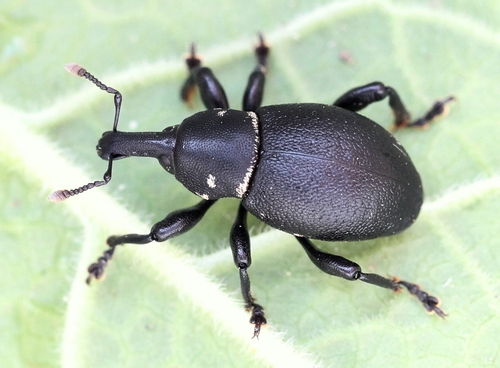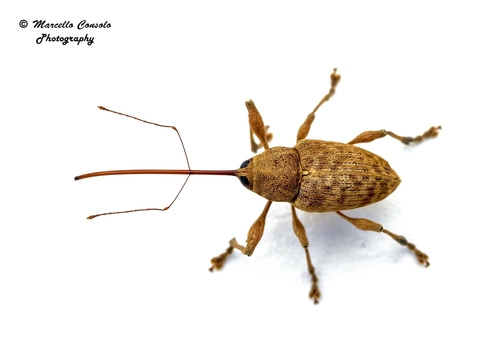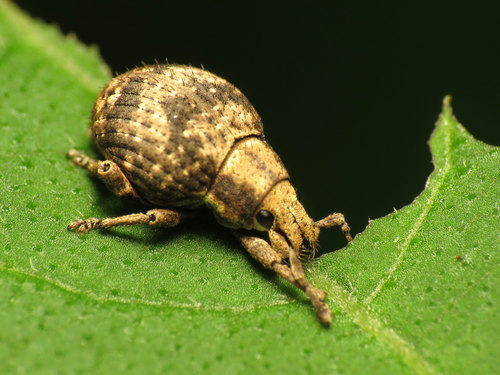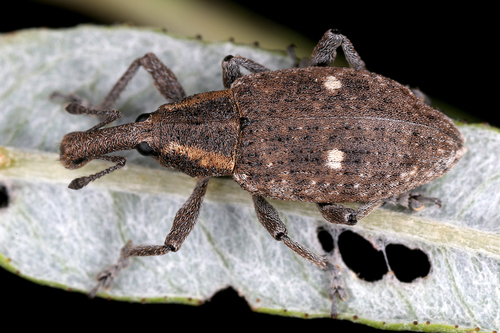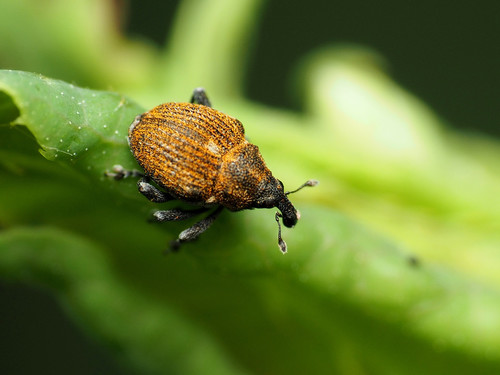
About Rhinoncomimus latipes Korotyaev, 1997
Rhinoncomimus latipes, commonly called the mile-a-minute weevil, is a weevil species belonging to the beetle family Curculionidae. This weevil is highly co-evolved with its host plant, Persicaria perfoliata (also called Polygonum perfoliatum), which is commonly known as mile-a-minute or Asiatic tearthumb. It has only been recorded successfully reproducing on mile-a-minute. Adult mile-a-minute weevils overwinter in leaf litter, emerging early in spring to feed on host plant leaves and mate. Females prefer to lay their eggs on the plant’s compact flowering head, a tender spot that lets larvae easily bore into the plant stem. Larvae hatch 3 to 5 days after eggs are laid, then bore into the stem to feed and complete their development. Larval stem boring and internal feeding significantly reduces the growth and reproductive ability of P. perfoliata. Once fully grown, larvae drop into the soil to pupate, and emerge as adult weevils by climbing up nearby plant stems, roughly one month after eggs were laid. Between three and four overlapping generations can develop over a single growing season. Native to Asia, Rhinoncomimus latipes was intentionally introduced to North America in 2004 to control invasive mile-a-minute, which has become established as a weed in several northeastern US states. To date, R. latipes has been effective at controlling mile-a-minute populations at its release sites. It strongly prefers mile-a-minute as a host over non-target native plant species, but it spreads slowly, with an estimated dispersal rate of approximately 4.3 kilometers per year from original release points. R. latipes has been distributed for release by hand, and also released aerially from unmanned aircraft in special 'bug pods' to reach hard-to-access locations.