About Rhinocheilus lecontei Baird & Girard, 1853
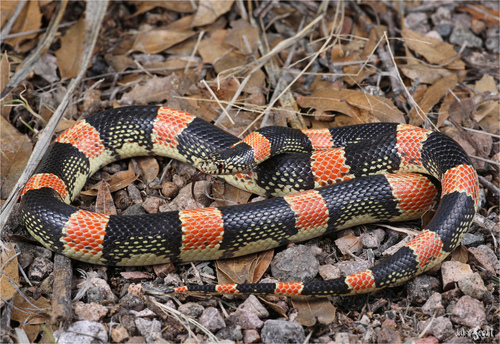
Rhinocheilus lecontei, commonly called the long-nosed snake, gets its common name from its long, slightly upturned snout. Its body is tricolor, with a general appearance that vaguely resembles a coral snake. It has black and red saddle-shaped markings over a yellow or cream-colored background, and cream-colored spots inside the black saddles are a distinct trait of this species. Among all harmless snakes in the United States, it is unique in having undivided subcaudal scales. Most adult long-nosed snakes reach a total length including the tail of 22 to 32 inches (56 to 81 cm), with a maximum recorded total length of 41 inches (100 cm). The long-nosed snake's preferred natural habitats are desert, grassland, shrubland, and savanna. This species is found from northern Mexico, ranging from San Luis Potosí to Chihuahua, and extends into the southwestern United States, where it occurs in California, Nevada, Utah, Idaho, Arizona, New Mexico, southeastern Colorado, southwestern Kansas, Oklahoma, and Texas. Rhinocheilus lecontei is oviparous; it lays clutches of 4 to 9 eggs in early summer, and the eggs hatch in late summer or early fall.