About Rhinanthus glacialis Personnat
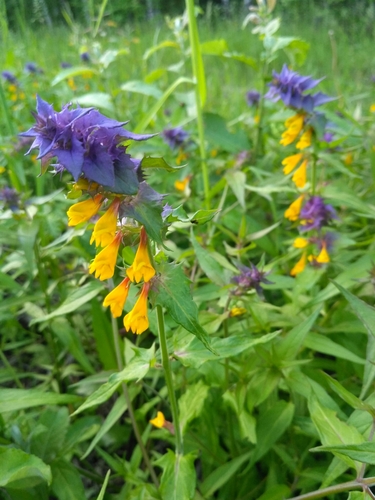
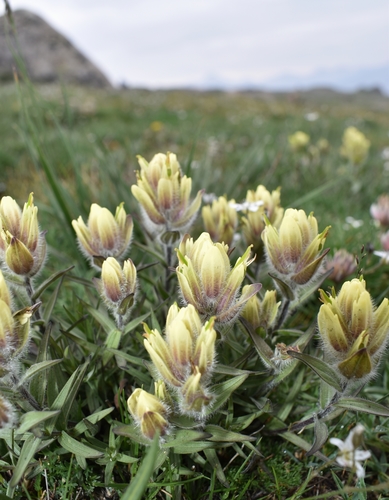
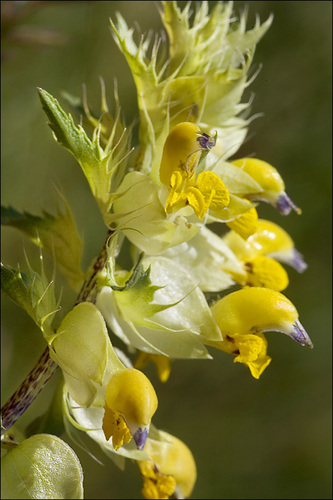
Rhinanthus glacialis Personnat is an upright-growing herbaceous rattle that reaches 10 to 50 centimetres in height. Its stem leaves are linear to lanceolate, sessile, serrated, and arranged oppositely along the stem. Its bright to sulfur yellow two-lipped (bilabiate) flowers are usually 1.5 to 1.8 centimetres long, arranged in a spike inflorescence. Each flower has a curved, open corolla tube and a distinct upper lip bearing 1–2 millimetre long purplish to whitish teeth. No trichomes (hairs) grow on the flower's calyx. The plant has bracts with 4–8 millimetre long bristle teeth. Its flowering period runs from June to September. Laypeople can easily mistake Rhinanthus glacialis for other similar rattle species, especially the European species Rhinanthus alectorolophus. R. glacialis can be distinguished from R. alectorolophus by its hairless or only slightly hairy calyx, stem, and leaves. The Orobanchaceae family, which this species belongs to, is well known for containing many species that are at minimum hemiparasites (partial parasites). Hemiparasitic plants rely on other host plants for mineral compounds and water, but produce their own organic compounds. Rhinanthus glacialis is a European species found mostly across Central Europe, ranging from southeastern France to the northwestern Balkan Peninsula. This relatively common rattle grows in cultivated and semi-dry meadows, fields (especially grain fields), various mountain slopes, screes, pastures, and other sunny areas. It inhabits altitudes from lowland regions to moderate-climate mountain habitats, and prefers slightly basic, humid soil with low nitrogen content.