About Rheum rhabarbarum L.
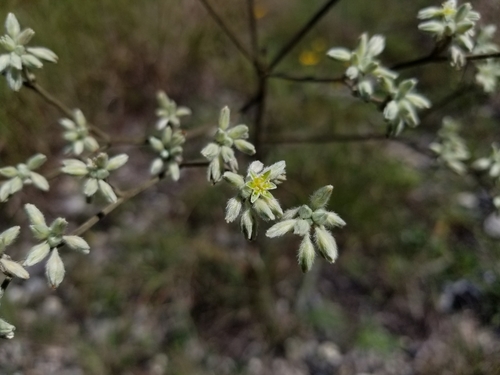
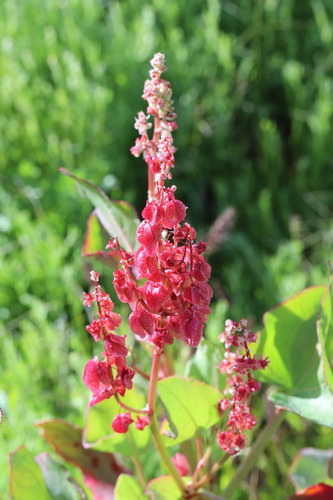
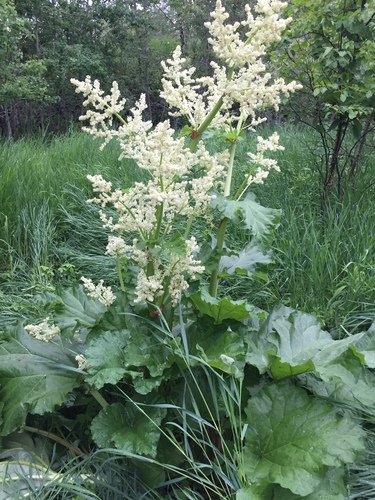
Rheum rhabarbarum L. is a flowering plant species belonging to the Polygonaceae family, native to a region extending from southern Siberia to northern and central China. For centuries, this plant has been harvested from the wild for its root, which was a widely popular medicinal product used across Europe and Asia. Later, it was purposefully cultivated for its root in England and Russia. It is recognized as one of the species that contributed to the development of culinary rhubarb, and the scientific name R. rhabarbarum is sometimes incorrectly applied to culinary rhubarb. Its native range covers the Daurian region of southeastern Siberia in Russia, around and east of Lake Baikal, as well as northern Mongolia. In China, it grows naturally in the northern provinces of Hebei, Heilongjiang, Henan, Hubei, Jilin, Inner Mongolia, Shanxi, and Shaanxi. In China, this species grows on mountain slopes at elevations between 1,000 and 1,600 meters. In Russia, it is found in sandy soil along field edges, on steppes, and in regionally uncommon small woodland copses. In its Chinese range, it flowers in June and produces fruit after July. Most recorded associations between insects and this species are confused by the incorrect application of the name R. rhabarbarum to plants of Rheum × hybridum. Because of this confusion, most insects reported to feed on this species are generalist insects from Europe or North America that do not actually feed on R. rhabarbarum, and are not native to the region where R. rhabarbarum naturally occurs. The only known exception is the butterfly Lycaena violacea: its caterpillars are only recorded to feed on R. rhabarbarum, and the butterfly's native range matches the range of this host plant, which fits the pattern of most Lycaena species being specialized feeders on plants in the Polygonaceae family. Cosmia trapezina var. exigua is roughly native to some of the same regions as R. rhabarbarum; its European variety has been found feeding on rhubarb in Finland, despite usually feeding on various tree species. Other insect species that have been recorded eating garden rhubarb and also occur within the native range of R. rhabarbarum include Arctia caja, Hydraecia micacea, Spilarctia luteum, and Xestia baja. Rheum rhabarbarum (which has the synonym R. undulatum) was one of several distinct Rheum species grown in Europe before the start of the 18th century. Initially, roots from a related species, likely R. rhaponticum, were used for medicinal purposes. A putative hybrid of uncertain origin, Rheum × hybridum, was also grown in cultivation. By the early 18th century, all three of these taxa were grown as vegetable crops in England and Scandinavia. These taxa hybridize easily with each other, and culinary rhubarb was developed through selection from open-pollinated seed, making it nearly impossible to confirm its exact origin. In physical appearance, culinary rhubarb shows continuous variation between the form of R. rhabarbarum and the form of R. rhaponticum. Modern culinary rhubarb cultivars are tetraploids with a chromosome count of 2n = 44, which differs from the 2n = 22 count found in wild species such as R. rhaponticum.