About Rheubarbariboletus armeniacus (Quél.) Vizzini, Simonini & Gelardi
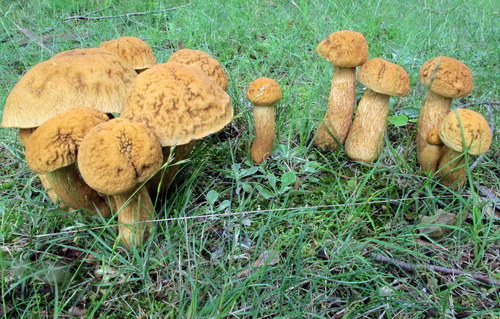
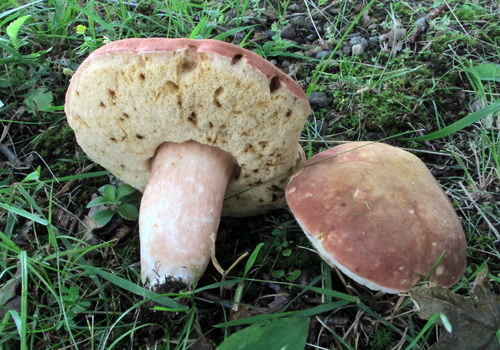
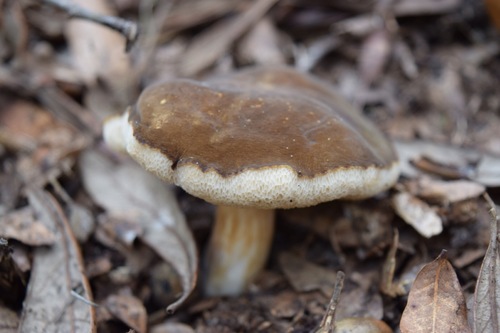
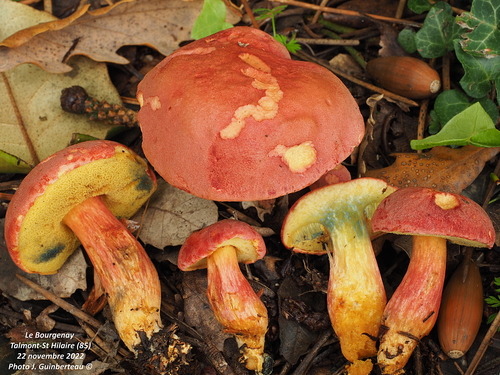
The cap of Rheubarbariboletus armeniacus starts out globular, then expands to become convex and eventually flattens slightly, reaching a diameter of 2–6 cm (3⁄4–2+3⁄8 in). The cap margin initially sticks to the stipe, and tends to become lobed or undulated as it ages. The cap surface is somewhat pubescent at first, becoming smooth and hairless later, and may develop cracks with age. The cap is orangish-apricot, fading to ochre as it matures. The tubes are pale yellow when young, become more vivid with age, and eventually develop greenish-yellow to greenish-olive tones. They turn pale blue when bruised. The pores are circular or slightly angular, with the same color and bruising reaction as the tubes. The robust stipe is 3–8 cm (1+1⁄8–3+1⁄8 in) long and 0.5–1.5 cm (1⁄4–5⁄8 in) thick. It is usually thicker in the middle or lower section, and its base grows into the substrate like a root. The top of the stipe is yellow; below this region, color is mostly covered by dense, fine reticulation that turns brown to brownish-crimson as the mushroom ages. In some specimens, the stipe cuticle cracks, and pointed patches lift away from the surface. The flesh is pale yellow in the cap, with a narrow strip of pinkish-yellow just under the cuticle; in the stipe, the flesh is orange-ochre with a reddish tint. The flesh sometimes changes slightly and temporarily to blue when cut or injured, but this change is not consistent across specimens. It has a pleasant odor and a fruity-acid taste. When treated with iron salts (FeSO4), the base of the stipe shows a green-blue reaction. Spores are fusiform (spindle-shaped), measuring 10–15 by 4.5–6 μm. The spore-bearing basidia are club-shaped, four-spored, and contain internal oil droplets; they measure 28–35 by 9–12 μm. Cystidia are fusiform, hyaline (translucent), and measure 40–55 by 9–12 μm. This species has been recorded forming ectomycorrhizal associations with white poplar (Populus alba) in Hungary. Its ectomycorrhizae contain bright yellow pigments, especially in the rhizomorphs, and have warts on the outer surfaces of both rhizomorphs and the mantle. The ectomycorrhizae of R. armeniacus cannot be reliably told apart from those of Xerocomus subtomentosus.