About Rhapidophyllum hystrix (Fraser ex Thouin) H.Wendl. & Drude
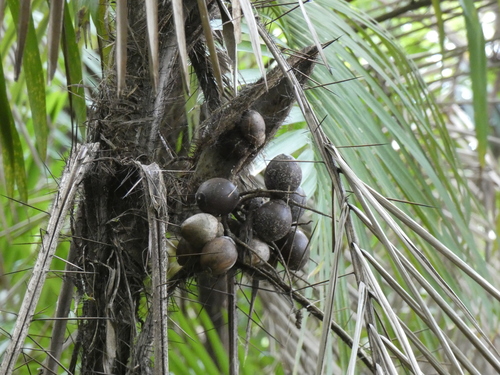
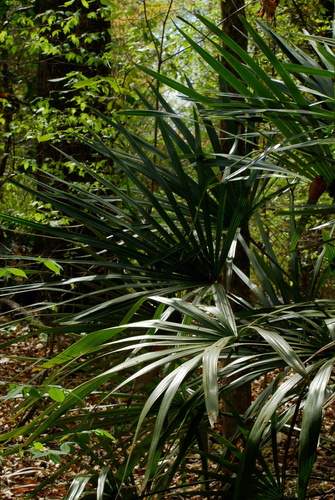
Needle palm, scientifically named Rhapidophyllum hystrix (Fraser ex Thouin) H.Wendl. & Drude, grows as a clumping, shrub-like plant, with multiple slow-growing stems emerging from a single base. These stems grow tightly together, eventually forming a dense base 1 to 1.2 meters (3.3 to 3.9 feet) tall. Numerous sharp, needle-like spines 10 to 25 centimeters (3.9 to 9.8 inches) long grow between the leaves; these spines protect the stem’s growing point from browsing animals. The full plant can reach 2 to 3 meters (6.6 to 9.8 feet) tall when measured to the top of its upright central leaves. It is a fan palm belonging to the family Arecaceae, subfamily Coryphoideae. Its leaves have a long petiole that ends in a rounded fan holding 8 to 16 leaflets. Each entire leaf can grow up to 2 meters (6.6 feet) long, while individual leaflets reach 60 to 80 centimeters (24 to 31 inches) in length. Flowers grow in dense, short clusters at the top of the stems. The species is usually dioecious, meaning male and female flowers grow on separate individual plants. Its fruit is a brown drupe that is roughly 2 centimeters (0.79 inches) long. In cultivation, needle palm is very popular with palm enthusiasts in temperate climates, because it can tolerate modest cold. Some sources report it can survive temperatures as low as −26 °C (−15 °F), though it suffers heavy damage at this temperature and recovers after. More realistic cold tolerance estimates put the limit closer to −21 °C (−5 °F), which causes damage to foliage. Recovery from winter damage is far less reliable in climates with cool summers, such as the Pacific Northwest and northwestern Europe. In the United States, needle palm can be reliably cultivated along the East Coast from Florida to Connecticut, and along the entire West Coast from southern California to Washington. In the U.S. interior, large, well-established specimens have been growing in Tennessee, the southern Ohio Valley, and Washington, DC at the United States National Arboretum since the 1960s. It is the most popular landscaping palm in Maryland’s Chesapeake Bay area. Needle palms require hot summers to thrive, and the species does not grow well in cool summer climates. This palm is considered commercially exploited and therefore threatened. When buying a needle palm, it is recommended to only purchase from a reputable dealer, because some unethical dealers harvest wild specimens directly from natural populations.