About Rhaphiolepis indica (L.) Lindl.
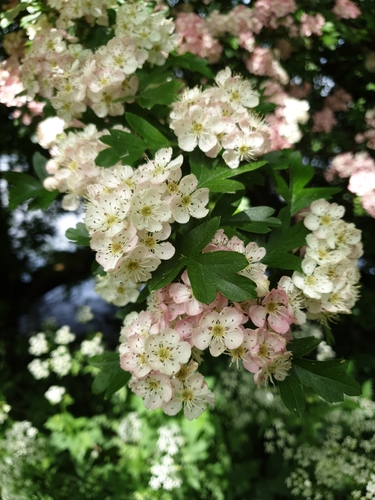
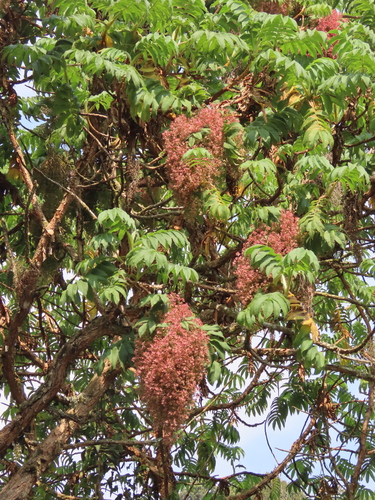
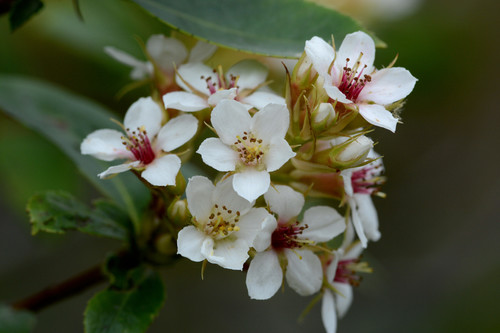
Rhaphiolepis indica (L.) Lindl. grows as a shrub or small tree, rarely reaching 4 meters in height. When young, its branches are purple-brown, cylindrical, and covered in brown tomentum; as they age, branches turn greyish brown and become glabrous. The petiole measures 0.5–1.8 cm long, or is nearly absent; it is lightly brown or tomentose, and becomes subglabrous. Stipules are deciduous, lanceolate, covered in a light layer of brown tomentum, and end in an acuminate apex. Leaf blades are ovate, oblong, and more rarely obovate, oblong-lanceolate, narrowly elliptical, or elliptical-lanceolate, measuring (2–) 4–8 cm long by 1.5–4 cm wide. The blades are coriaceous; veins are prominent on the abaxial surface, reticulate veins are visible abaxially and may or may not be visible adaxially. The abaxial leaf surface is pale, and is either glabrous or has sparse tomentum; the adaxial surface is shiny and glabrous, with an obtuse, acute, or acuminate apex. Inflorescences form as panicles or terminal clusters, and hold either many or few flowers. Both pedicels and peduncles are covered in rusty tomentum; bracts and bracteoles are deciduous. Open flowers measure 1–1.5 cm in diameter. Petals are white or pink, shaped obovate or lanceolate, and measure 5–7 mm long by 4–5 mm wide; they are pubescent at the base, and have an obtuse apex. There are 15 stamens, which are the same length as the petals or shorter. This species grows on slopes, roadsides, and in shrubs along stream banks, at altitudes between 700 and 1600 meters above sea level. Its native range includes southern China, Japan, Laos, Cambodia, Thailand, and Vietnam. It is cultivated for its decorative pink or white flowers, and is popular in bonsai culture. Its cooked fruit is edible and can be used to make jam. Rhaphiolepis indica is a common horticultural specimen in the southern United States, used in both commercial and private landscapes. It is often trimmed into small compact hedges or balls for use as foundation plants, and can also be successfully pruned into a standard form, or into small dwarf-like trees up to 15 feet in height. This species is prone to developing leaf spot.