About Rhaphiolepis bibas (Lour.) Galasso & Banfi
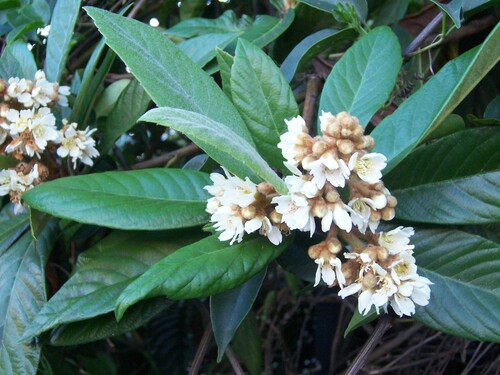
This entry originally describes Eriobotrya japonica under the scientific name Rhaphiolepis bibas (Lour.) Galasso & Banfi. E. japonica is a large evergreen shrub or small tree, with a rounded crown, short trunk, and woolly new twigs. Mature specimens can grow 5–10 metres (16–33 feet) tall, but are often smaller, reaching around 3–4 m (10–13 ft). Fruit ripening occurs from spring to summer, depending on local temperatures. Its leaves are alternate and simple, measuring 10–25 centimetres (4–10 inches) long. They are dark green, tough and leathery in texture, with a serrated margin, and are covered in dense yellow-brown velvety pubescence on their lower surface. Young leaves also have dense pubescence on their upper surface, but this coating rubs off quickly. The plant is originally native to China, where related related species grow in the wild. It grows in locations where winter temperatures are generally above 10°F (-12°C), including Georgia, Argentina, Armenia, Afghanistan, Australia, Azerbaijan, Bermuda, Brazil, Chile, Colombia, Kenya, Syria, India, Iran, Iraq, Lebanon, Türkiye, Israel, Palestine, Jordan, South Africa, the entire Mediterranean Basin, Pakistan, New Zealand, Réunion, Tonga, Central America, Mexico, South America, and warmer parts of the United States such as Hawaii, California, Texas, Louisiana, Mississippi, Alabama, Florida, Georgia, and South Carolina. Its maximum native range in the United States extends to coastal Oregon and Washington, southern Tennessee, and most of North Carolina, where it grows in favorable humid subtropical climates with relatively mild winters. China is the world's largest producer of this species, growing 400,000 tonnes annually. Spain is the second largest producer with 41,487 tonnes annually, half of which is sent to export markets. Loquat (the common name for this plant) has several additional uses. It can be used to make animal feed, and its medicinal uses include treating vomiting and thirst. Its wood can be used as a substitute for pear wood, and works well for crafting rulers and other writing instruments. In Europe, its flowers are used to make perfume, though the yield of fragrance from the flowers is considered low. Powdered loquat leaves are also used to treat diarrhea and depression, and to reduce the effects of alcoholic intoxication.