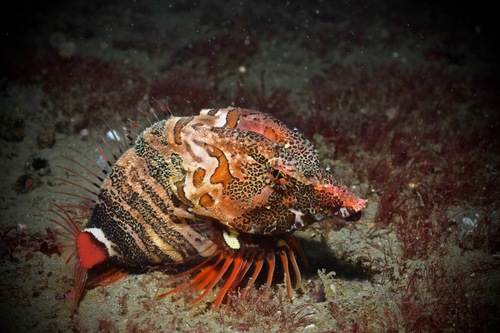
About Rhamphocottus richardsonii Günther, 1874
Common Name and Size
Rhamphocottus richardsonii, commonly known as the grunt sculpin, reaches a maximum recorded total length of 8.9 cm.
Body and Fin Morphology
This species has a large head, short stout body, elongated pig-like snout, and orange fins. Its body is typically yellow with brown stripes, and its pectoral fins are a particularly vivid orange.
Mouth and Snout Trait
Compared to other sculpins, it has a small mouth paired with a longer snout, which affects its feeding habits.
Locomotion
While it is capable of swimming in an unusual upright posture with its head pointing upward, it mostly moves by "hopping" along the ocean floor using its pectoral fins.
Distinguishing Phenotypic Traits
It can be distinguished phenotypically by several key traits: its pectoral fins are separated from the upper lobe, it retains both anal and dorsal fins, and its hypural-parhypural bone is formed as a single solid piece.
Geographic Distribution
The grunt sculpin is distributed along coasts of the eastern Pacific Ocean, ranging from southern California north to the Bering Sea; it has also been observed off the coast of Japan.
Habitat Types
Within this range, it occupies a diverse set of habitats including rocky shores, kelp forests, sandy beaches, and reefs.
Depth Range
It is most commonly found in shallow water as little as two meters deep, but has been recorded at depths up to 165 meters.
Shelter Preference
It prefers to shelter inside empty giant barnacles, and will instead inhabit debris under piers and floats when giant barnacles are not available.
Barnacle Mimicry Behavior
When sheltering inside barnacles, it extends its fins and waves them to mimic the appearance and movement of the feeding cirri of a living barnacle.
Spawning Period and Location
Spawning for grunt sculpins takes place on rocky shores between August and October.
Reproductive Behavior
Females are the dominant partner during reproduction; they chase and trap males within rocky crevices until they have laid their full clutch of approximately 150 eggs.
Egg Hatching
Eggs hatch between 16 and 20 weeks after fertilization, with the exact timing depending on water temperature.
Larval Occurrence Period
Larval grunt sculpins have been recorded between March and June.
Larval Survival Requirements
Larvae must stay close to shore to survive, as any larvae carried out into the open ocean by planktonic dispersal are very unlikely to survive.
Larval Behavior Uncertainties
It remains unclear how larvae are adapted to remain near shore, or what environmental factors influence this behavior.


