About Rhamphicarpa fistulosa (Hochst.) Benth.
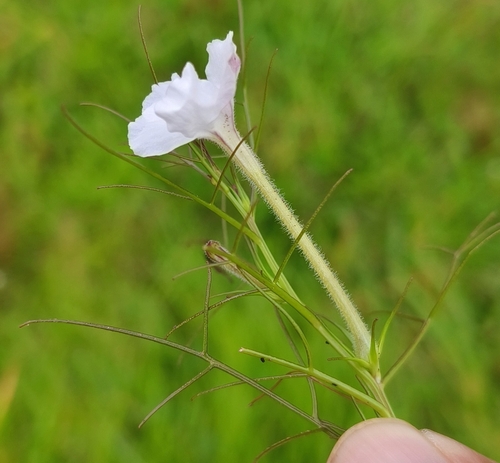
Rhamphicarpa fistulosa, commonly known as rice vampireweed, is a flowering plant species that belongs to the genus Rhamphicarpa and the family Orobanchaceae; it was previously classified in the family Scrophulariaceae. This plant is pale green, and may turn reddish as it reaches maturity. It has needle-like leaves and white flowers that feature long corolla tubes. Its flowers only open after sunset, and it is thought that they are pollinated by night moths. Rhamphicarpa fistulosa has a broad distribution across Africa, ranging from Guinea to Madagascar and from Sudan to South Africa. It can also be found in New Guinea and northern Australia. Rhamphicarpa fistulosa is an annual, facultative hemi-parasitic forb species. It is very widespread across seasonally flooded wetlands in tropical and sub-tropical Africa, and it has become increasingly important as a parasitic weed in African rain-fed lowland rice systems, where it typically causes yield losses of more than 60%. It is an especially problematic weed in rice fields that experience temporary, uncontrolled flooding. Currently, few management strategies are available for Rhamphicarpa fistulosa. Hand-weeding, permanent flooding, fertilizer applications, and the use of herbicides are the known effective control measures. In addition, a number of high-yielding, resistant and tolerant rice varieties have recently been identified. A team of researchers from the Africa Rice Center (AfricaRice), Wageningen University, FAO, and the national research centers of Tanzania (MARI), Côte d'Ivoire (CNRA), and Benin (INRAB) is studying Rhamphicarpa fistulosa. The team investigates the species' importance as a parasitic weed of rice, seeks to clarify its biology, ecology, and host damage mechanisms, and develops management strategies together with participating farmers. Researchers also study the economic and social determinants and impact of this weed, and analyze national extension and crop protection systems. This work aims to identify constraints and challenges for the effective control and prevention of invasive pests like Rhamphicarpa fistulosa. The research project, called PARASITE, is funded by the Netherlands Organisation for Scientific Research - Science for Global Development, and receives additional financial support from the CGIAR Research Program on Climate Change, Agriculture and Food Security (CCAFS). To date, the PARASITE project (www.parasite-project.org) has produced 10 published SCI journal papers. Other groups that conduct research on Rhamphicarpa fistulosa include the Laboratory of Applied Ecology, Department of Natural Research Management, Faculty of Agronomic Sciences, University of Abomey-Calavi, P.O. Box 526, Cotonou, Benin, and AgroSup Dijon, UMR 1347 Agro-ecologie Pôle EcolDur, 17 rue Sully, BP 86510, 21065 Dijon cedex, France.