About Rhamnus lycioides L.
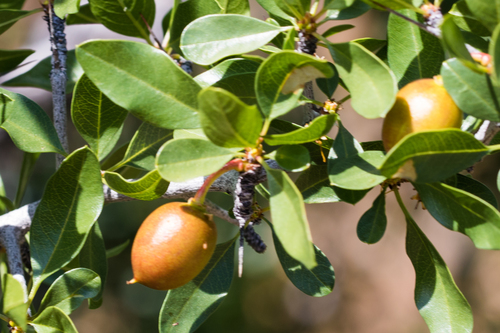
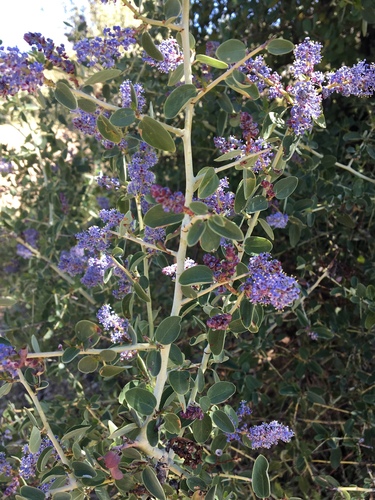
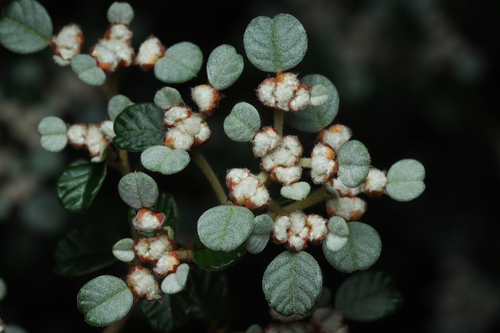
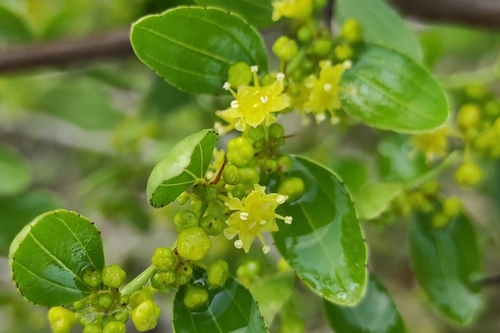
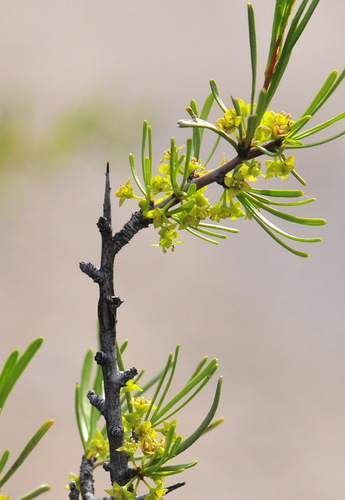
Rhamnus lycioides L. is a slow-growing shrub adapted to dry Mediterranean climates. It is a deciduous or evergreen shrub reaching 1.5–4 meters in height, with a tangled, thorny, heavily-branched growth form. Its bark is grayish, and young stems end in a thorn. The light green leaves measure 0.5 to 3.5 centimeters long and 0.3 to 1 inch wide, with leaf tips ranging from obtuse to apiculate. Leaves are entire, smooth (glabrous), and shaped from linear to obovate: narrow and elongated, sometimes slightly widened toward the apex. They may be leathery and persistent. Lateral veins show little to no visible marking on the leaf underside. Its yellow, very small, inconspicuous flowers grow in groups, appearing in winter. Flowers form either solitary or in small clusters in leaf axils, are greenish-yellow with 4 triangular lobes, and the calyx has four sharp angles. Petals are either rudimentary or completely absent. Fruits are ovoid, 4-6 millimeters across, starting yellowish and turning black as they ripen. The berry-like fruit holds one or more seeds, depending on the subspecies. This species does not flower and produce fruit at the same time. In a single population, different specimens bear fruit in different months, extending the availability of this fruit as a food source for birds that disperse the plant’s seeds. The berry is purgative, very bitter, and toxic to humans when consumed in large quantities. In ecology, this species is distributed across central, eastern, and southern Iberian Peninsula, with a broader range throughout the Mediterranean region, specifically including Spain, the Balearic Islands, other Mediterranean islands and islets, northern Africa, the Apennine Peninsula, and former Yugoslavia. It naturally grows on rocky, nutrient-poor soils. Its natural habitats include sclerophyllous forests, pine woods, oak woods, holm oak woods, and Quercus coccifera woods. It also occurs in scrubland, and can grow alone as a pioneer species in severely degraded drylands. The species is resilient to overgrazing and trampling by livestock, highly resistant to drought, and prefers calcareous soils. In extremely dry, windy climates, it grows on rock outcrops. It can survive in desert areas that receive only 200 mm of annual rainfall. It thrives in dry forests and scrub growing under Kermes oak, Holm oak, Aleppo pine, and juniper. It is a very hardy species that occupies poor, gritty, heavily eroded soils. Along with gorse and thistles, it is one of the last species to disappear from overgrazed areas, and provides invaluable value to small birds, offering fruit food as well as protection and support for bird nests. It is especially important to desert birds because its fruits have a high water content. While the fruit can cause death in mammals, it is regularly consumed by ants and birds.