About Rhamnus cathartica L.
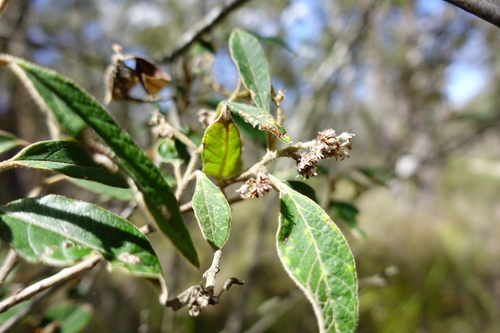
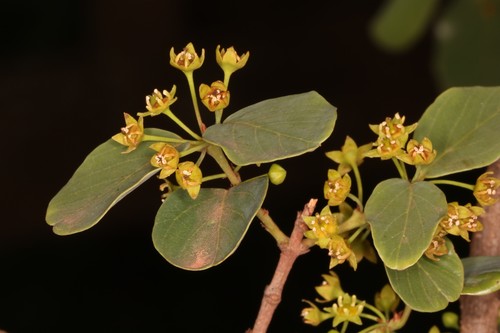
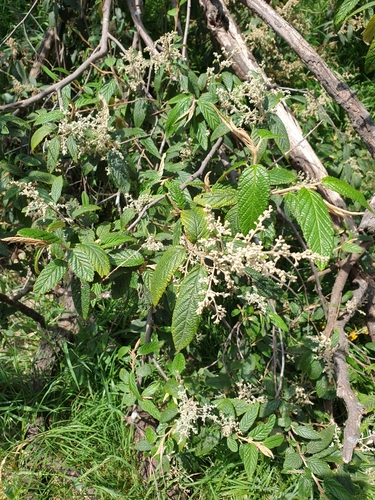
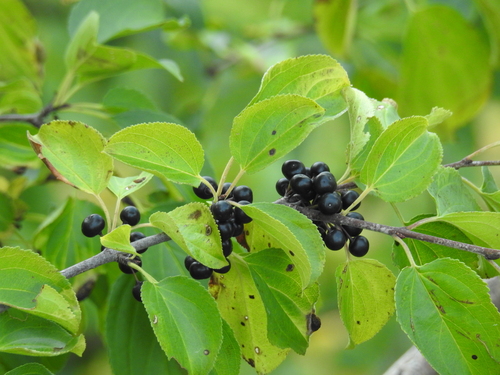
Rhamnus cathartica L. is a deciduous, dioecious shrub or small tree that reaches up to 10 metres (33 ft) in height. It has grey-brown bark and often thorny branches. Its leaves are elliptic to oval, ranging 25–90 mm (1–3+1⁄2 in) long and 12–35 mm (1⁄2–1+3⁄8 in) wide; they are green, turn yellow in autumn, have toothed margins, and may be arranged in opposite to subopposite pairs or alternately. The yellowish-green flowers have four petals, are dioecious, insect-pollinated, and bloom from April to June. The fruit is a globose black drupe 6–10 mm (1⁄4–3⁄8 in) across, holding two to four seeds. Visually, Rhamnus cathartica can be confused with the closely related Frangula alnus, as well as Cornus sanguinea, a species from a different plant family. Carl Linnaeus originally published this species under the name Rhamnus catharticus, but the spelling was corrected to cathartica, since the genus name Rhamnus is treated as feminine. Ecologically, Rhamnus cathartica is shade-tolerant, grows at a moderate rate, and is short-lived. It serves as a food plant for the brimstone butterfly, Gonepteryx rhamni; the presence of the butterfly's sulphur-yellow males indicates this species or its alternative host Frangula alnus is growing nearby. Rhamnus cathartica is the alternate host for Puccinia coronata, the fungus that causes crown rust disease in cereals. When the fungus passes through this host species, it causes leaf damage and reduces photosynthesis. In North America, Rhamnus cathartica is also the primary overwintering host for the soybean aphid, a major agricultural pest of soybeans. The seeds and leaves of Rhamnus cathartica are mildly poisonous to humans and most other animals, but birds readily eat the fruit and disperse the seeds in their droppings. The toxins from the plant cause stomach cramps and laxative effects, which may aid seed dispersal; the compounds responsible for this laxative action are anthraquinone and emodin. The species epithet cathartica and the common name purging buckthorn both reference this effect. In 1994, R. cathartica was linked to an outbreak of idiopathic neurological disease in horses, though no causative agent was ever officially confirmed. In trials where rodents were fed R. cathartica leaves and stems, their glycogen metabolism became abnormal, and glycogen deposits formed in the cytoplasm of liver cells; abnormal glycogen metabolism is linked to diabetes in humans. In traditional medicine, the bark and fruit of Rhamnus cathartica were used as a purgative, but this use is generally discontinued today because the fruit produces violent action that can have dangerous effects on the body. Evidence shows it was regularly used as a purgative in some medieval monastic settings: excavation of latrine pits at the Benedictine Abbey of St Albans in the 1920s uncovered large numbers of buckthorn seeds mixed with fragments of cloth the monks used as lavatory paper. The wood of this species is hard and dense, and its bark produces a dye.