About Rhacophorus nigropalmatus Boulenger, 1895
Nomenclature
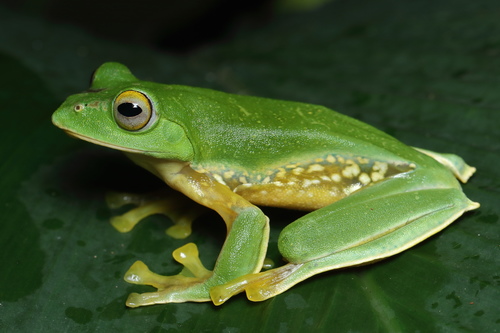
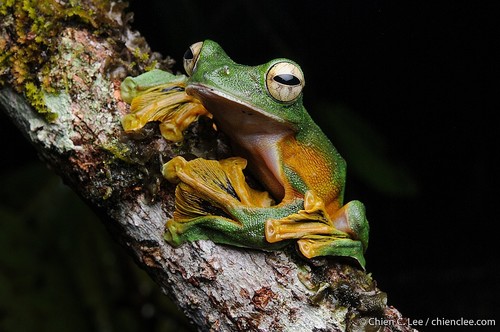
This species of flying frog, Rhacophorus nigropalmatus Boulenger, 1895, commonly known as Wallace's flying frog, is very photogenic thanks to its large size, bright colors, and unique behavior.
Body Size
It reaches a body length of approximately 80–100 mm, with males being smaller than females, making it one of the largest species in the Rhacophorus genus.
Head Features
It has large eardrums and large eyes with horizontal pupils.
Limb and Webbing Structure
Its limbs are very long, and both its fingers and toes are fully webbed all the way to their tips.
Gliding Adaptation
Combined with a fringe of skin stretching between its limbs, this frog is able to parachute down to the forest floor from the high tree canopies where it normally lives.
Dorsal and Ventral Coloration
The frog's back is bright shiny green, and its underside ranges from white to pale yellow.
Toe and Webbing Coloration
The upper inner sides of its toes, as well as the outer sections of its finger and toe webbing, are bright yellow.
Distinctive Dark Markings
The base of the webbing and a single spot on each flank are solid jet black.
Similar Congeneric Species
This species closely resembles the green flying frog Rhacophorus reinwardtii and Rhacophorus kio.
Differentiation from Similar Species
However, even fully grown individuals of those two species do not reach the size of Wallace's flying frog, and they have more orange-colored web fringes.
Arboreal Habit
Wallace's flying frogs live almost entirely in trees, and only descend to mate and lay eggs.
Gliding Behavior
They can leap and glide, often referred to as flying, between trees or to bushes.
Gliding Trigger
When threatened or searching for prey, they leap from a branch and spread their four webbed feet.
Gliding Mechanism
They use their patagia (the membranes between their toes and loose skin flaps on their sides) to catch air during their fall, which allows them to glide.
Gliding Distance
They can glide 15 meters (50 feet) or more to a neighboring tree branch or even all the way to the ground.
Landing Adaptations
They also have large, oversized toe pads that help them land softly and cling to tree trunks.
Diet
Their diet consists mainly of insects, but they have been recorded eating toads and small birds as well.
Known Predators
Known predators of this species include tree-climbing snakes.
Nest Construction
Females create a bubble nest by lashing fluids that they produce, placing the nest on a branch or foliage above water.
Egg Fertilization
They lay their eggs inside the nest, and the male fertilizes the eggs externally.
Tadpole Hatching
After hatching, tadpoles remain in the nest until it breaks apart, at which point they fall into the water below.
Larval Development
They continue their development in the water and eventually undergo metamorphosis into juvenile frogs.
Juvenile Coloration
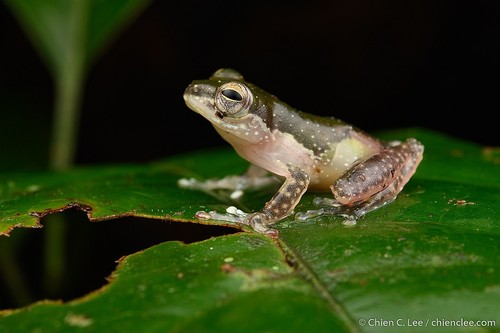
Young frogs are reddish brown with white spots for roughly one year, before maturing into their green adult coloration.
Juvenile Patterning Function
This juvenile patterning is thought to discourage predation by mimicking feces.
Geographic Distribution
This frog is distributed across Thailand, Myanmar, Peninsular Malaysia, the Indonesian island of Sumatra, and Borneo (which spans Brunei, Malaysia, and Indonesia).
Habitat Vegetation
It inhabits trees, palm trees, bushes, and similar plants.
Elevation and Habitat Type
It can be found in both undisturbed primary forest and areas that have previously been logged, at elevations ranging from 700 to 1800 feet above sea level.