About Rhabdophis subminiatus (Schlegel, 1837)
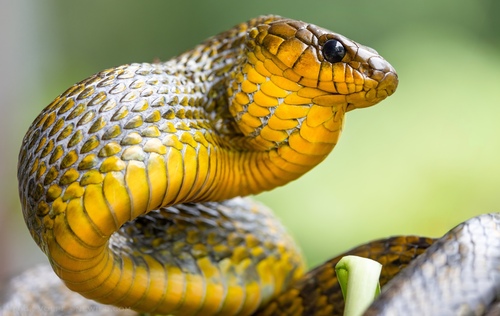
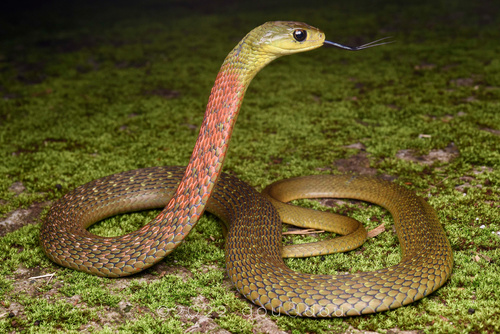
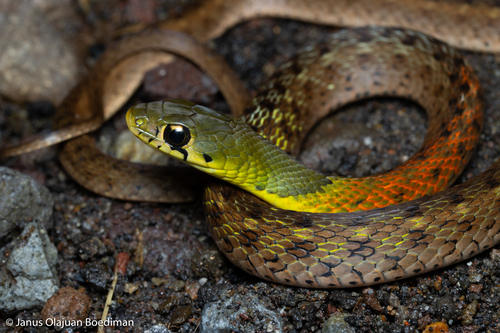
This species, Rhabdophis subminiatus, commonly called the red-necked keelback, has a greenish base color, with red and yellow markings near its head. Adults reach a total length (including the tail) of 70 to 90 cm, or 27.5 to 35.5 inches, and females grow much larger than males. During mating season, multiple males may compete for a single female. Rhabdophis subminiatus is currently only found on the Indonesian islands of Java and Sumatra. Historically, this species was thought to have a far broader geographic range, but this understanding changed once researchers recognized that the original classification described a species complex rather than a single species. The red-necked keelback typically lives near ponds, and its diet consists of frogs, fish, lizards, and small mammals. It also eats poisonous toads, and stores the bufotoxins from these consumed toads in its nuchal glands, which are located in the colored red region of the snake's neck. Bufotoxins cause tachycardia, drooling, convulsions, and eventually paralysis; when the snake is threatened (for example, by being touched), it can rupture its nuchal glands to release the stored toxin. Rhabdophis subminiatus is a rear-fanged snake, and was long considered harmless to humans. However, after one fatal and several near-fatal human envenomations, the toxicity of its venom was studied, and the species has recently been reclassified as dangerous. In general, rear-fanged snakes need to bite and hold on, or bite repeatedly, to produce envenomation in humans, but recent reports document that even brief bites from this species can result in severe envenomation, organ failure affecting the kidneys and liver. A chewing motion helps the snake deliver venom, because its venom ducts open to fangs that are externally grooved (not hollow) and located at the back of the mouth. Rhabdophis subminiatus has enlarged, ungrooved teeth, with two enlarged teeth at the rear of the jaw. A gland called Duvernoy's gland, located in the upper jaw, produces an extremely venomous secretion. When the snake bites, the venom-saliva mixture is not injected; it instead flows into the puncture wounds created by the rear teeth of the upper jaw, which are able to penetrate human skin. Envenomation by Rhabdophis subminiatus causes internal bleeding including brain hemorrhage, nausea, coagulopathy, and disseminated intravascular coagulation. When the venom was tested on animals, it also caused kidney failure. Medical providers should use caution when treating bite victims; unnecessary invasive procedures like injections should be avoided because they can cause excessive bleeding. While most bites to humans from this species only involve its front teeth and do not cause harmful effects, rare bites that involve the rear fangs can be lethal. Studies testing the biological activity of red-necked keelback venom in mice found that the venom contains a potent factor X activator, has strong defibrinogenating activity, and has overall low proteolytic activity. This low proteolytic activity correlates with the venom's negligible fibrinogenolytic and fibrinolytic activities. Only one tested antivenom showed weak neutralizing activity against this venom in mice. This species has recently been added to the schedule of the United Kingdom's Dangerous Wild Animals Act 1976.