About Rhabdophis plumbicolor (Cantor, 1839)
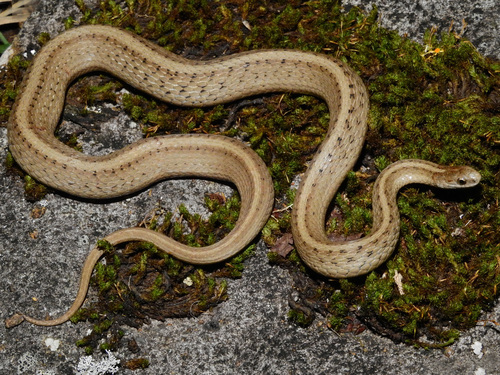
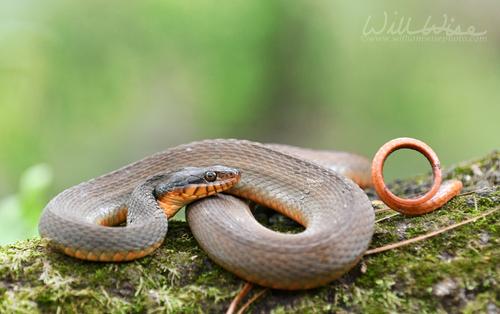
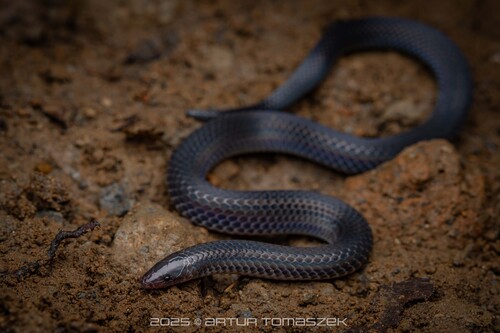
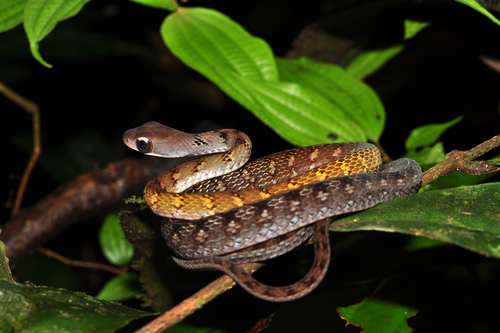
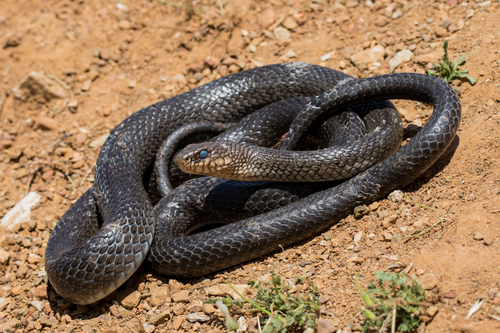
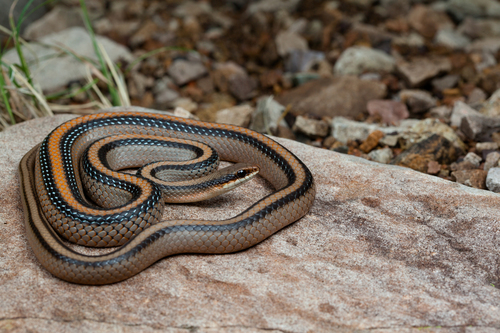
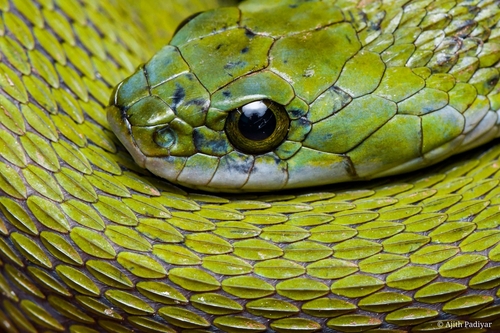
Rhabdophis plumbicolor has a stout, viper-like body structure. When fully grown, its total length including the tail is about 2 feet (61 cm). It has a moderately large eye, and its rostral scale is only just visible from above. The suture between the internasals is the same length as the suture between the prefrontals, or a little shorter. The frontal scale is as long as its distance from the tip of the snout or slightly longer, and as long as the parietals or slightly shorter. The loreal scale is as long as it is deep, or longer, and sometimes touches the eye. There are two preocular scales and three or four postocular scales. Temporals are arranged as 2 + 3 or 4. There are 7 supralabial (upper lip) scales, with the third and fourth touching the eye. 4 or 5 infralabial (lower lip) scales contact the anterior chin shields, which are shorter than the posterior chin shields. Dorsal scales are strongly keeled, arranged in 23 to 27 rows at midbody. There are 144 to 160 ventral scutes, the anal scale is usually divided, and there are 35 to 50 subcaudal scales. The dorsal coloration of R. plumbicolor is dull green, uniform across the body or with faint black markings. Juveniles have an inverted black V-mark on the neck that points forward and extends to the frontal scale, with a second much smaller black mark behind it; the area between these two marks is bright yellow or orange. Juveniles also have a black stripe running from the eye to the corner of the mouth, plus more or less regular transverse spots or cross-bars on the back and tail. The belly is whitish, yellow, or plumbeous, and rarely has darkish spots. R. plumbicolor is distributed across peninsular India and Sri Lanka, where it occurs especially in hilly landscapes. William Ruxton Davison found a large specimen at an elevation of 4,700 feet (1,400 m) in the Anaimalai Hills. The species also occurs in Pune (Maharashtra), Bangladesh, and Myanmar, and possibly occurs in Pakistan. R. plumbicolor is oviparous.