About Reynoutria sachalinensis (F.Schmidt) Nakai
Reynoutria sachalinensis, commonly known as giant knotweed or Sakhalin knotweed, has taxonomic synonyms Polygonum sachalinense and Fallopia sachalinensis. This species is native to northeastern Asia, occurring in northern Japan (Hokkaidō, Honshū) and the Russian Far East (Sakhalin and the southern Kurile Islands).
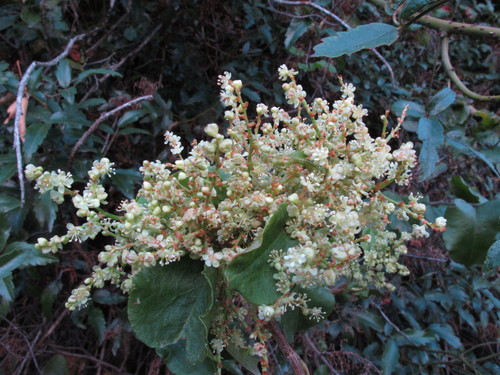
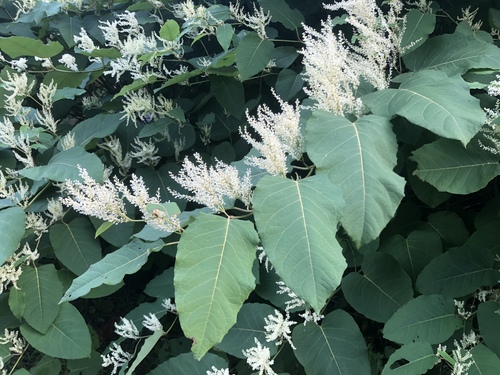
It is a herbaceous perennial plant that grows 2–4 m (79–157 in) tall, with strong, extensively spreading rhizomes that form large clonal colonies. Its leaves are among the largest in the family, reaching up to 15–40 cm (6–15.5 in) long and 10–28 cm (4–11 in) broad. The leaves are nearly heart-shaped, with a somewhat wavy, crenate margin. Small flowers are produced on short, dense panicles up to 10 cm (4 in) long in late summer or early autumn; this species is gynodioecious, with male and male-sterile female flowers growing on separate plants.
Reynoutria sachalinensis is closely related to Japanese knotweed, Reynoutria japonica. It can be distinguished from R. japonica by its larger overall size, heart-shaped (not straight) leaf base, and crenate leaf margin. Its chromosome count is 2n=44.
The tender shoots of this plant are edible. It was introduced to Europe and grown in many botanic gardens, and came to prominent attention around 1893. That year, a drought in western Europe caused a major shortage of cattle forage; this species was barely affected, and livestock ate its tender shoots and leaves, so it was widely grown experimentally as a forage crop. It ultimately proved less useful than predicted, so deliberate cultivation has been almost entirely abandoned. Like F. japonica, it has become an invasive weed in several areas. It hybridizes with Reynoutria japonica in cultivation, producing the hybrid Reynoutria × bohemica (Chrtek & Chrtková) J.P.Bailey, which is frequently found in the British Isles and elsewhere.
Extracts of this plant can be used as plant protectants against certain fungal and bacterial diseases. Rhizomes of R. sachalinensis are the source of substrates for the lactoperoxidase peroxidation cycle, which can act as activators and inhibitors of the antimicrobial properties of this system. This species has been cultivated as an energy crop for biomass production, particularly in Germany in its commercial variety 'Igniscum'. It shows high productivity even in Northern latitudes, reaching an annual dry matter yield of 5.4 to 27.8 oven dry metric tons per hectare (2.4 to 12.4 short ton/acre).