About Reynoutria japonica Houtt.
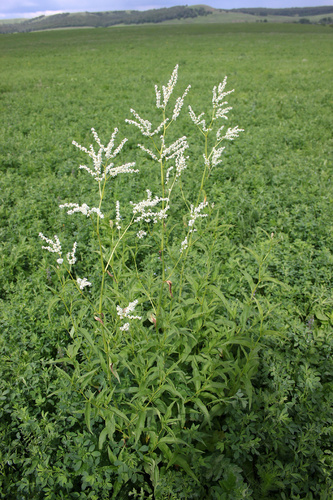
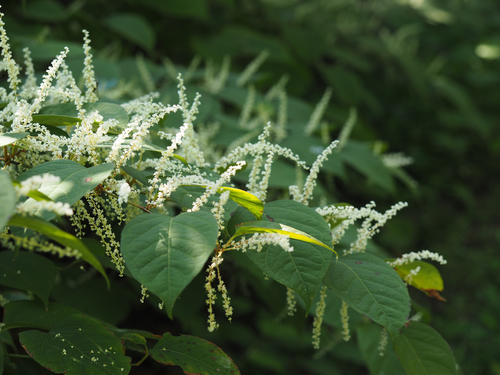
Reynoutria japonica Houtt., commonly known as Japanese knotweed, produces small cream or white flowers. These flowers grow in erect racemes 6 to 15 centimetres (2+1⁄2 to 6 inches) long, and bloom in late summer and early autumn. The species has hollow stems with distinct raised nodes that give it a bamboo-like appearance, though it is not related to bamboo. Stems can reach a maximum height of 3 to 4 metres (10 to 13 feet) in a single growing season, though much smaller plants are commonly found growing through pavement cracks or in areas where they are repeatedly cut down. Mature leaves are broadly oval with a truncated base, measuring 7 to 14 centimetres (3 to 5+1⁄2 inches) long and 5 to 12 centimetres (2 to 4+1⁄2 inches) wide, with smooth entire margins. Mature leaves are green, shaped like a heart flattened at the base or a shield, and typically around 12 centimetres (5 inches) long. Newly emerged leaves of R. japonica are dark red and 1 to 4 centimetres (1⁄2 to 1+1⁄2 inches) long. Young developing leaves are green, rolled back, and have dark red veins. Leaves grow alternately from stem nodes in a zigzag pattern. Mature R. japonica forms dense thickets 2 to 3 metres (6+1⁄2 to 10 feet) tall. Immature plants, or plants restricted by mowing or other factors, have much thinner, shorter stems than mature plants, and these stems are not hollow. This species is native to East Asia, specifically Japan, China, and Korea. In North America and Europe, it has successfully established populations across numerous habitats, and is classified as a pest and invasive species in several countries. Some beekeepers value Japanese knotweed as an important nectar source for honeybees, since it flowers at a time of year when few other plants bloom. It produces a monofloral honey that beekeepers in the northeastern United States usually call bamboo honey; this honey has a mild flavor similar to a mild version of buckwheat honey, which comes from a related plant also in the Polygonaceae family. The young stems of Japanese knotweed are edible as a spring vegetable, with a flavor similar to rhubarb. In some locations, semi-cultivating Japanese knotweed for food has been used as a method to control knotweed populations that invade sensitive wetland areas and displace native vegetation. It is eaten in Japan as sansai, a type of wild foraged vegetable. In Europe, young shoots have been used in restaurant cuisine. Japanese knotweed can grow up to 30 centimetres per day, making it a fast-growing vegetable that tolerates poor quality soils. It is resistant to over-harvesting, so it is more commonly foraged than cultivated as a vegetable. The plant can be eaten either raw or cooked. Ground-feeding songbirds and gamebirds also eat its seeds.