About Retrophyllum rospigliosii (Pilg.) C.N.Page
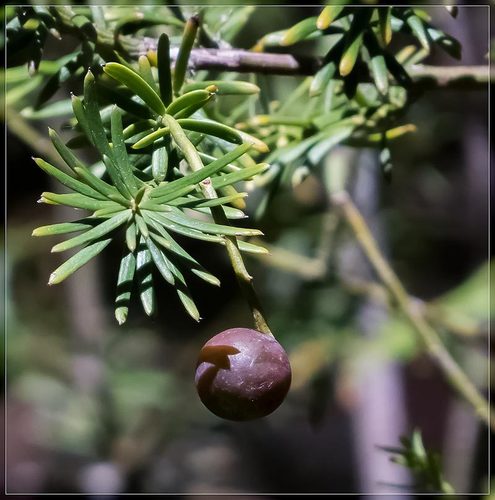
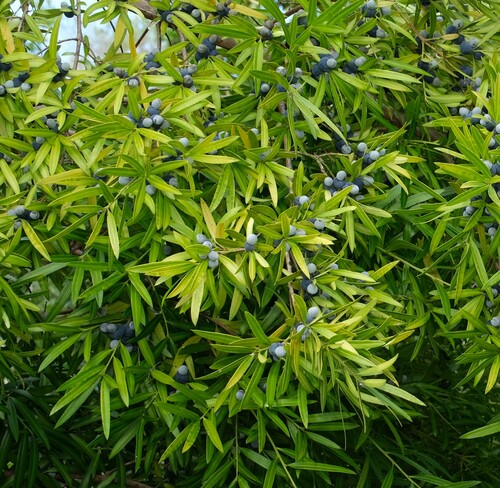
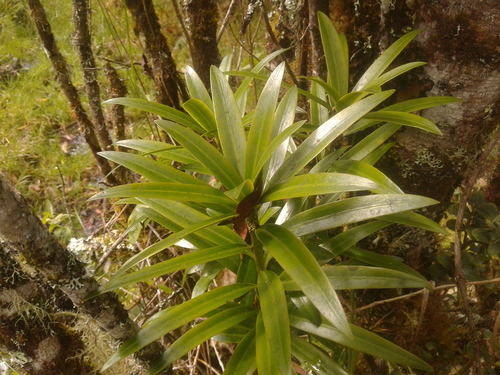
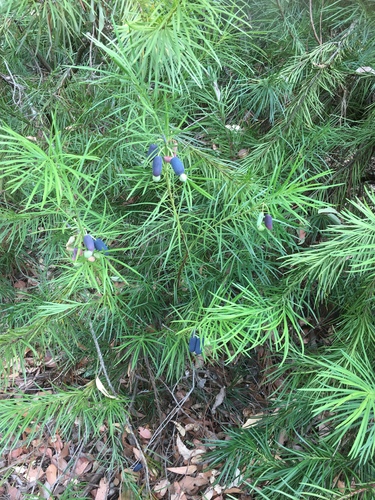
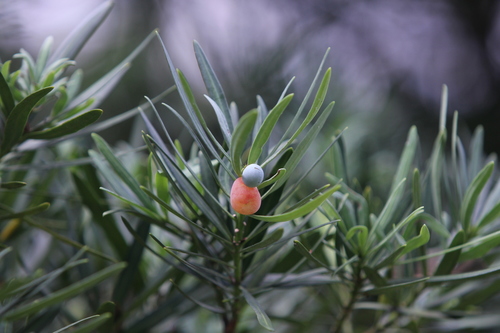
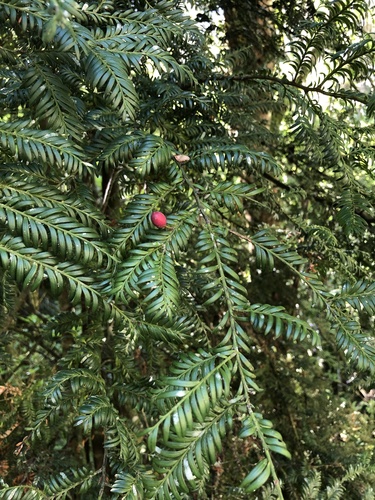
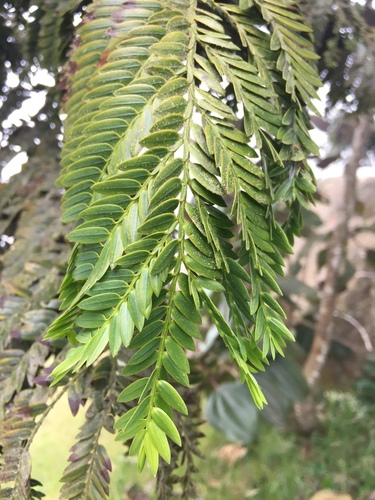
Retrophyllum rospigliosii is an evergreen tree that reaches up to 45 meters in height and 1.8 meters in trunk diameter. Its trunk is typically erect and straight, and the crown develops a rounded or oval shape as the tree matures. Branches are usually ascending or spreading, but become pendulous in shaded sections of the crown. Young bark is brown, and weathers to dark gray as it ages, exfoliating in scale-like flakes. Most leaves are flattened, with a decurrent base and a spreading blade, though leading shoots may also bear appressed scale-like leaves. Leaves are arranged spirally, but are twisted on lateral branchlets to look pectinate and nearly opposite. The pectinate leaves are twisted at their petioles in opposite directions on each side of the shoot, so the adaxial side of leaves faces upward on one side of the shoot and downward on the other side. Leaf blades are most often 10 to 18 millimeters long and 3 to 5 millimeters wide, with an ovate-lanceolate or ovate-elliptic shape, visible midribs, and entire margins. Stomata are present on both leaf surfaces. This species is dioecious. Male pollen cones measure 5 to 7 millimeters long, and have spirally arranged triangular sporophylls. Female seed cones each produce a single subterminal fertile cone scale with one ovule that develops into a seed. The seed is enclosed by a fleshy epimatium, which is initially green or glaucous and turns red when mature. The mature epimatium is 18 to 25 millimeters long, and ranges in shape from subglobose to ovoid-pyriform. Retrophyllum rospigliosii is native to northwestern South America, where it occurs naturally in Bolivia, Colombia, Ecuador, Peru, and Venezuela. It is a large rainforest tree that grows in montane tropical rainforests and cloud forests, at altitudes between 1500 and 3750 meters above sea level. It most often grows scattered among other trees, most of which are angiosperms, but can form pure stands on certain sites.