About Retiboletus ornatipes (Peck) Manfr.Binder & Bresinsky
Retiboletus ornatipes, commonly called the ornate-stalked bolete or goldstalk, is a bolete fungus species belonging to the family Boletaceae. It was first described under the name Boletus ornatipes by American mycologist Charles Horton Peck in 1878, and was moved to the genus Retiboletus in 2002.
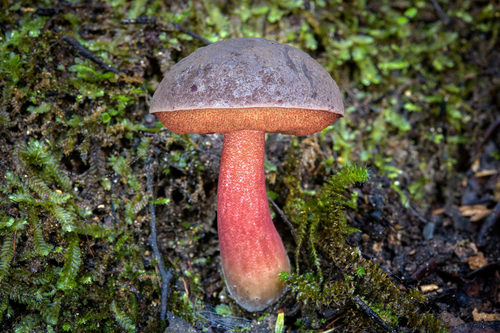
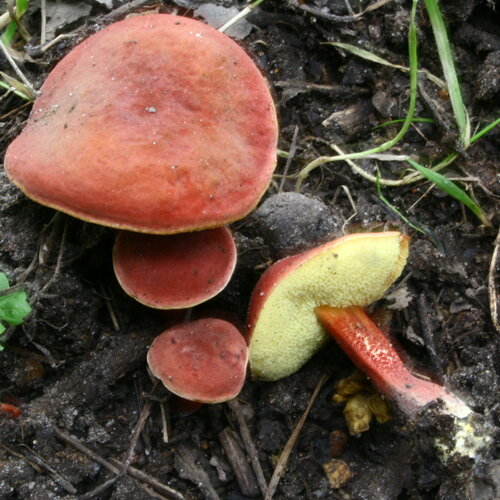
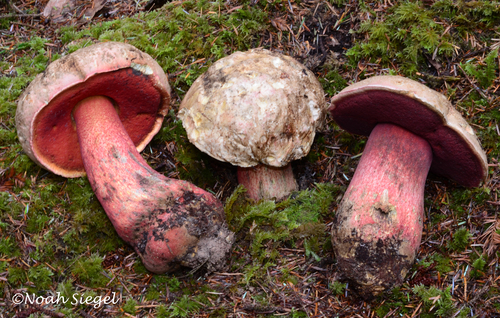
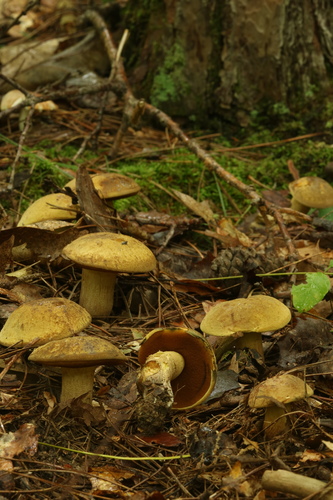
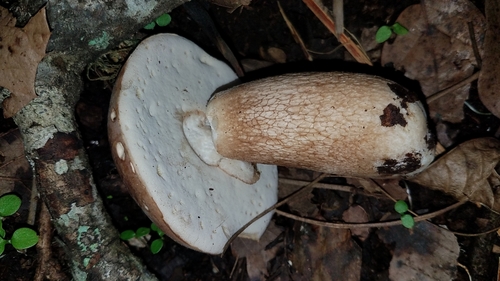
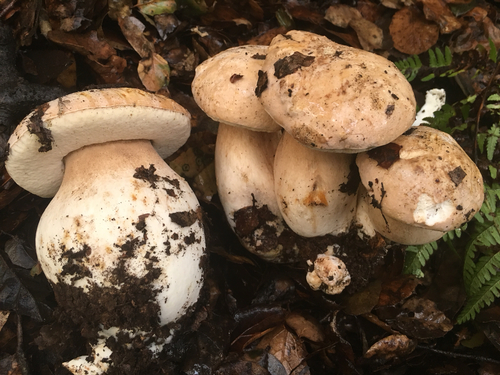
The cap of this fungus is convex, measures 4 to 20 centimetres (1+1⁄2 to 8 inches) wide, and is yellow, gray, or brown in color, and stains orangish when handled. Its stem is 6 to 12 cm (2+1⁄4 to 4+3⁄4 in) tall and 1 to 2.5 cm (1⁄2 to 1 in) thick. The flesh is yellow, with a taste that ranges from mild to bitter. The spore print of the species is tannish brown. It grows under oak and beech trees in eastern North America, and can be found between July and September. Different sources disagree on its edibility: one mushroom guide lists R. ornatipes as inedible, while another calls it a choice edible. Reports indicate the species is generally edible when it does not have a bitter taste.