About Remusatia vivipara (Roxb.) Schott
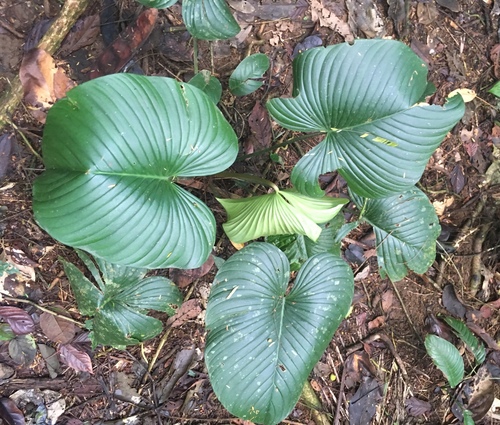
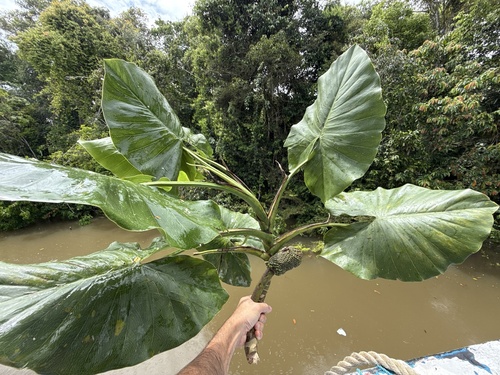
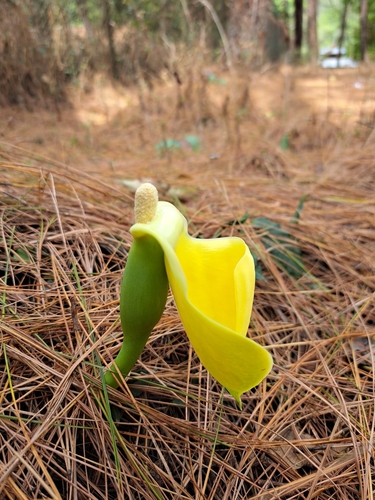
Remusatia vivipara (Roxb.) Schott is a rupicolous or epiphytic herb that grows up to 50 cm tall. It grows from an underground tuber 2–4 cm in diameter, which is colored vivid red. Its scaly, ovoid bulbils are around 5 mm long, with scales that end in hooked prickles. It produces a single broad, peltate leaf that is 10–40 cm long, 5–30 cm across, with a petiole up to 40 cm long. This species very rarely produces flowers. When flowers do form, the spathe is leathery, 10–13 cm long, with an ovoid green tube. The spadix is around 3.5 cm long, clavate, and creamy white. Flowers are unisexual and congested, with female flowers at the base, male flowers at the tip, and sterile flowers separating the two groups in the middle. Fruits form as a cluster of berries. Remusatia vivipara is distributed across Central and Western Africa, ranging from Tanzania and Ethiopia to Sierra Leone, as well as Oman, Yemen, Taiwan, Tibet, Yunnan, India, Indochina, Java, and Northern Australia. It grows in subtropical forests, on rocks and cliff edges between 700 m and 1900 m above sea level, and can also grow as an epiphyte in leaf litter traps on large trees such as Ficus vasta. This species rarely flowers in Asia, never flowers in Africa, and there are no recorded observations of it flowering in Arabia. Instead of relying on sexual reproduction, the small bulbils that form on the plant are easily detached, and can cling to bird feathers to be carried hundreds of kilometers, which explains the species’ very wide distribution. The tubers of Remusatia vivipara are edible after thorough cooking by either roasting or boiling, which deactivates harmful oxalate crystals. In Dhofar, cooked tubers are eaten with clarified butter or buttermilk, and in India they are added to curries.