About Regulus calendula (Linnaeus, 1766)
Scientific Nomenclature
The ruby-crowned kinglet, scientifically named Regulus calendula (Linnaeus, 1766), is a very small bird.
Size Measurements
Adults measure 9 to 11 cm (3.5 to 4.3 in) in length, have a wingspan of 16 to 18 cm (6.3 to 7.1 in), and weigh 5 to 10 g (0.2 to 0.4 oz).
Plumage Base Coloration
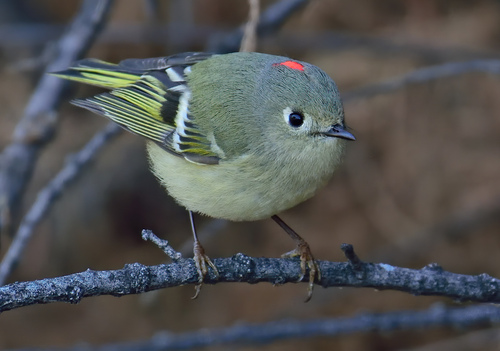
Its upperparts are gray-green, and its underparts are olive-buff. It features two white wingbars and a broken white eye ring.
Wingbar Details
The wingbar on the greater secondary coverts, which lies closer to the wing tip, is wider, and sits next to a dark band.
Head Pattern & Male Crown
The species has a relatively plain face and overall head pattern; adult males have a scarlet-red crown patch, which is usually concealed by surrounding feathers. Rarely, this crown patch may be orange, yellow, or entirely absent.
Female Plumage
Females are identical to males in all features except the crown patch.
Immature Plumage
Immature birds resemble adult females, as young males do not develop a crown patch.
Locomotion Patterns
Ruby-crowned kinglets usually move along branches or through foliage via short hops, and fly in bursts of rapid wing beats. They are constantly active, and are easily recognized by their characteristic wing-flicking behavior.
Flight Characteristics
Their flight has been described as "swift, jerky, and erratic".
Comparison to Golden-crowned Kinglet
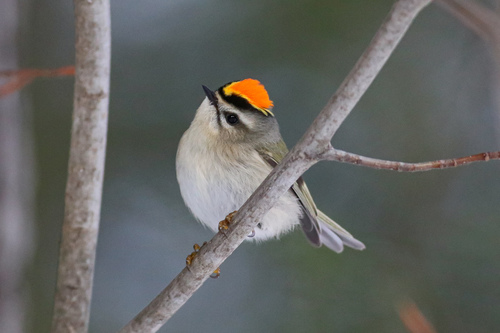
Compared to the closely related golden-crowned kinglet, the ruby-crowned kinglet is slightly larger, more elongated in shape, and has greener plumage.
Similar Species: Hutton's Vireo
This species can be confused with Hutton's vireo, which also performs wing-flicking, although less frequently than the ruby-crowned kinglet. It may also be mistaken for the dwarf vireo in Mexico.
Vireo Distinguishing Features
However, both of these vireo species are larger, have stouter bills and legs, and lack the black wing bar that marks the ruby-crowned kinglet.
Breeding Habitat
The breeding habitat of the ruby-crowned kinglet is coniferous forests across Canada, Alaska, northern New England, and the western United States.
Nesting & Clutch Size
They build a well-concealed hanging cup nest from downy plant material and feathers, suspended from a conifer branch, and may lay up to twelve eggs in a single clutch.
Population Trend
Recent counts from Breeding Bird Surveys show that the ruby-crowned kinglet population is increasing, mainly due to the discovery of less disturbed territory farther north that supports more successful breeding.
Nominate Subspecies Range
The nominate subspecies, R. c. calendula, breeds from northwestern Alaska across Canada all the way to the maritime provinces. It can also be found during the breeding season across the northern tier of the United States, and along southerly high-elevation spurs in the Rocky Mountains and Sierra Nevada.
R. c. grinnellii Details
The subspecies R. c. grinnellii breeds from southeastern Alaska to British Columbia, and differs significantly from R. c. calendula: it is smaller with shorter wings, its upperparts are darker and greener, its underparts are buffy rather than grayish-olive, and its vent is tinged yellow rather than dull whitish-olive.
Extinct Subspecies
The subspecies R. c. obscurus, native to Guadalupe Island off Baja California, was last sighted in 1953 and is considered extinct.
Interspecific Hybridization
Possible hybridization between ruby-crowned kinglets and golden-crowned kinglets has been reported.