About Ratibida pinnata (Vent.) Barnhart
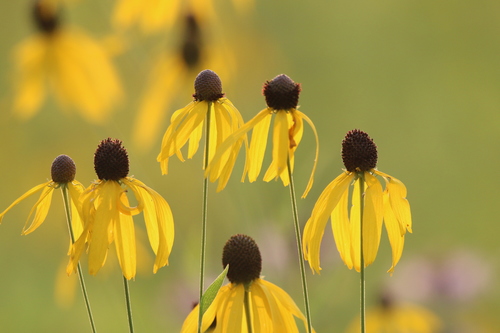
Ratibida pinnata (Vent.) Barnhart is a species of flowering plant in the family Asteraceae, with common names including pinnate prairie coneflower, gray-head coneflower, yellow coneflower, and prairie coneflower. It is native to the central and eastern United States, as well as Ontario, Canada. This species is a perennial herb that can grow well over 1 meter (3 ft 3 in) tall. It has fibrous roots, along with rhizomes or woody caudices. Its rough-haired, glandular leaves reach up to 40 cm (16 in) long, and are divided into several large lance-shaped or oval lobes. Its inflorescences grow tall, typically standing far above the plant’s highest leaves. Each flower head holds up to 15 yellow ray florets, each up to 6 cm (2+1⁄4 in) long. The center of the flower is globular or oval, and measures up to 2.5 cm (1 in) long. This center is covered in 200 or more disc florets that range in color from yellow-green to purplish. When crushed, the disc heads give off a scent that resembles anise. This plant grows in prairies, along wood margins, and on roadsides. It can tolerate both moist and dry habitats. It is hardy, and is not easily outcompeted by other plants. It is grown as an ornamental garden plant, and is attractive to butterflies and birds. One known cultivar is 'Sunglow'.