About Ratibida columnifera (Nutt.) Wooton & Standl.
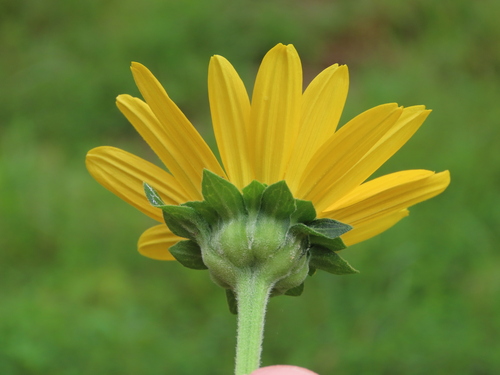
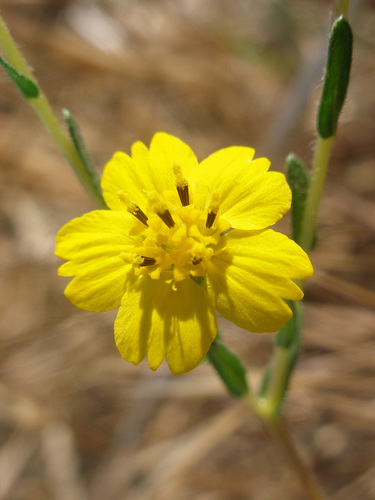
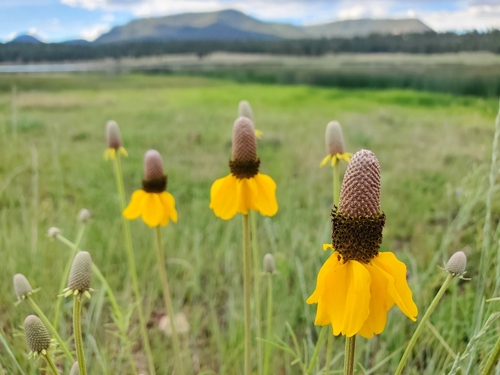
Ratibida columnifera has medium green, hairy stems that branch occasionally, and reaches 30–91 cm (1–3 ft) in height. Its leaves are also hairy, alternate, deeply pinnate with 5 to 11 lobes, growing up to 15 cm (6 in) long and 5 cm (2 in) across, with petioles that reach up to 5 cm (2 in) in length. The stem's terminal inflorescence holds 4 to 12 drooping, sterile ray florets; these may be yellow, brownish red, or brown with yellow borders, and they surround a central column up to 5 cm (2 in) long. This column is formed from numerous purplish disk florets, which open in bands that begin at the column's base and progress upward. Flowering occurs from June to September. Ratibida columnifera is native to the range from southern Canada to northern Mexico. In Canada, it is native to Alberta, British Columbia, Saskatchewan, and Manitoba. In the United States, its native range reaches Idaho to the west and north, Texas to the south, and Massachusetts to the east. It grows in sunny, well-drained sites including upland prairies, pastures, roadsides, and open disturbed areas. The Zuni people prepare an infusion of the whole plant to use as an emetic. This species, commonly called prairie coneflower, is valued by gardeners for xeriscaping and native plant gardens for its color and rich fragrance. When grown in garden settings, plants are often biennial: they grow vegetatively in their first year, then die after blooming in their second year. Prairie coneflower needs dry to medium soil moisture, rarely develops serious disease or pest problems, and is hardy in USDA zones 4–9.