About Rathinda amor (Fabricius, 1775)
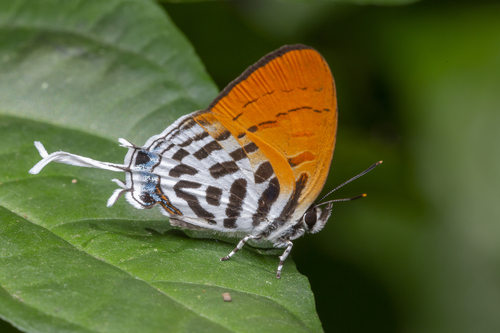
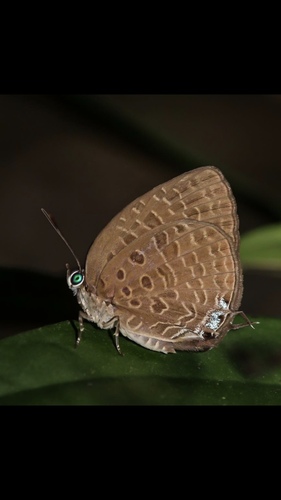
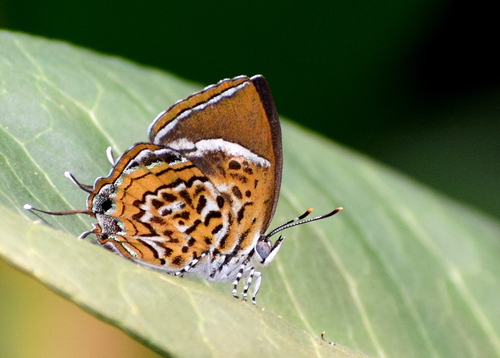
This species is the butterfly Rathinda amor (Fabricius, 1775). Description of the male: Upperside is brownish-black with a violet tint. The forewing has a white spot (sometimes slightly ochreous) beyond the end of the cell, with two smaller spots arranged in an outwardly oblique row from this main spot. The hindwing has two black lunular spots between the tails, plus faint indications of a third black spot in the next upper interspace; all three spots are capped with orange, and have a fine blue thread along their outer edges. The tails are black, with white tips. Cilia are blackish, with white tips. Underside is white, sometimes tinged with yellow, and markings are pale chocolate. On the forewing, the apical third is chocolate; its inner edge forms an even curve from the middle of the costa to the hinder margin near the angle, and contains a sub-marginal series of small black lunules that are inwardly edged with white. The middle portion of the white area has some chocolate suffusion, with a thin linear mark near the hinder angle, two short streaks extending from the base, followed by three or four small spots. On the hindwing, there is a lunulated, outwardly curved discal line. The inner area of the wing is covered with spots and small lunular marks. There is a sub-marginal orange-yellow band, lined on its inner side with dark chocolate, and on its outer side with small metallic blue-green spots. There is some pale chocolate suffusion near the apex. A black spot between the two upper tails is ringed with pale dull blue, with white spots on each side of it. There is some white on the outside of the yellow band near the costa. Both wings have a terminal, narrow chocolate band with an ochreous tint. Antennae are black, ringed with white; the club has an orange tip. The head and body, above and below, match the wing color. The female is similar to the male both above and below, but the white spots on the forewing upperside are larger. Habitat: This species is endemic to South Asia, specifically the Western Ghats of India, southern Indian plains, Bangladesh, and Sri Lanka. It grows well in jungles with moderate to heavy rainfall and scrub forests below 900 m (3,000 ft). It prefers undergrowth, but can be spotted along forest paths and clearings. It may also be found in gardens that contain one or more of its host plants. Food plants: This butterfly feeds on soapberries, myrtles, mangos, and plants from the families Rubiaceae (notably Ixora coccinea), Dipterocarpeae, Euphorbiaceae, and Loranthaceae.