About Raphia farinifera (Gaertn.) Hyl.
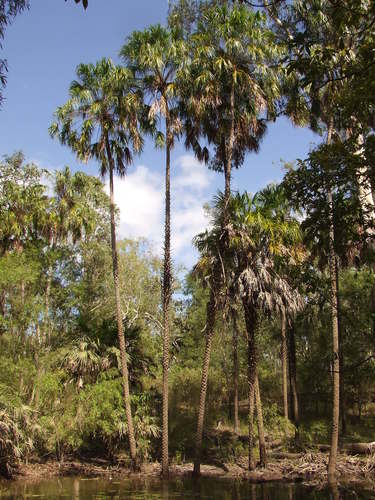
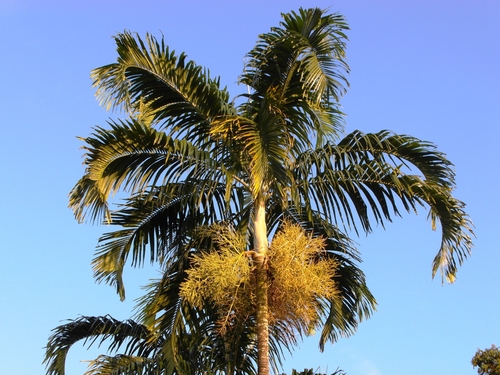
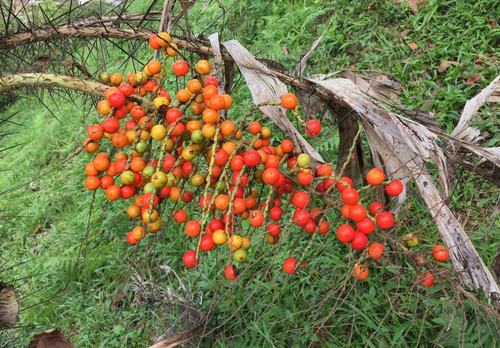
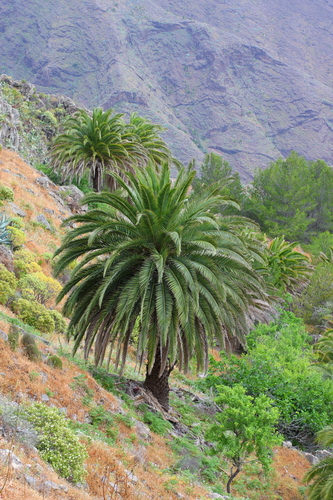
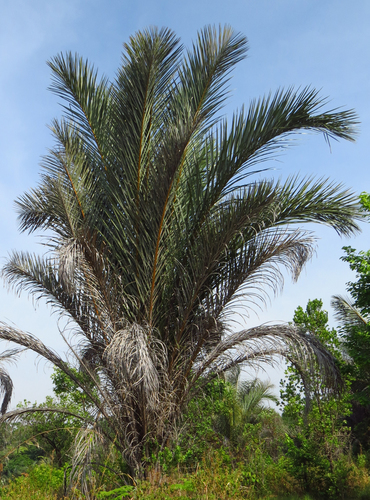
Raphia farinifera (Gaertn.) Hyl. is a tropical African palm tree. It grows in lowland riparian and swamp forest, around human habitations, at cultivated locations, on stream banks, and other moist sites, at altitudes between 50 and 1000 m. It is naturally found in Angola, Benin, Burkina Faso, Cameroon, Gambia, Ghana, Guinea, Ivory Coast, Kenya, Madagascar, Malawi, Mauritius, Mozambique, Nigeria, Réunion, Senegal, Seychelles, Sierra Leone, Tanzania, Togo, Uganda, Zambia and Zimbabwe, and it is naturalised in the eastern lowlands of Madagascar. The genus name Raphia comes from the Greek word raphis, meaning 'needle', a reference likely to the 4 mm long yellowish spines that grow on the margins and main veins of its leaflets. The specific epithet farinifera refers to a starchy flour obtained from the tree's trunk pith: farina means 'flour' and fera means 'bearing'. This is one of 26 currently recognised species in the genus Raphia, all native to Africa and Madagascar. One species, Raphia taedigera, also grows in Central and South America. The fronds of Raphia palms, which are botanically a single leaf, are among the longest in the plant kingdom; fronds of Raphia regalis can reach 25 m in length. The trunk of Raphia farinifera grows up to 10 m tall and about 1 m in diameter, with the topmost fronds extending a further 10 m upwards. The trunk is sheathed in persistent leaf bases. These trees grow either singly or, because they produce suckers, in dense clumps. The pendant inflorescences of Raphia farinifera are massive, reaching up to 3.3 m (11 ft) long and up to 35 cm (14 in) thick. They bear unisexual flowers, with male flowers located at the distal end and female flowers at the proximal end. First order branches hold 13 to 32 very close-packed rachillae arranged in almost one plane. All Raphia species are monocarpic, or hapaxanthic: they flower and fruit only once, then die. Raphia farinifera flowers when the tree is around 20 to 25 years old, and it takes an additional 5 to 6 years from flowering for the fruit to ripen. All of the tree's fruits ripen at the same time. The fruit is oblong to ovoid, 5 to 10 cm in length, and covered in overlapping, glossy, golden-brown scales. Like all Raphia species, Raphia farinifera has the very rare 1/4 phyllotaxy. This species is strongly linked to human migration across the tropics, and it has a wide range of uses. Its leaves are used for thatching, its leaflets for plaiting, and its leaflet midribs are used as material for hut construction, furniture, fences, sweeping brushes, fishing net floats, ladders and poles. Raffia, a strong commercially important fibre, comes from the epidermis on the upper surface of young leaflets. This fibre is used as cordage in horticulture and handicrafts, and for weaving hats, baskets, mats, shoes, bags, fishing nets, hammocks, curtains and textiles. The midveins of the leaflets are also used to make fishing nets and other items for domestic use. The terminal portion of the tree's core is eaten as a vegetable. Young inflorescences are tapped to collect a sugary sap; tapping reduces flowering and hastens the tree's death. This sap is used to make palm wine, which can be distilled into strong alcohol or used as baking yeast. Fruit pulp is also used to make an alcoholic beverage. Oil can be extracted from the fruit's mesocarp (yielding 24% oil) and seed (yielding 1% oil); this oil is sometimes sold as 'bamboo oil' and is used to make raphia butter, soap, and stearin. The hard outer shell of the fruit is used to make snuffboxes and buttons, or used simply for decoration. Wax collected from the lower surfaces of leaflets is used to make floor polish, shoe polish, and candles. Raphia farinifera is frequently cultivated in locations including Nigeria, Madagascar, Seychelles, Réunion, India, the United States and the Lesser Antilles, and often becomes naturalised as a result of cultivation. It also has several medicinal uses. Preparations made from the root are used to treat toothache. Fibres from the leaf sheath are used to treat digestive disorders, and fermented sap from the inflorescence acts as a laxative. A decoction of fruit pulp is used to treat dysentery, and an infusion of the fruit stops haemorrhaging.