About Raphanus raphanistrum subsp. rostratus (DC.) Thell.
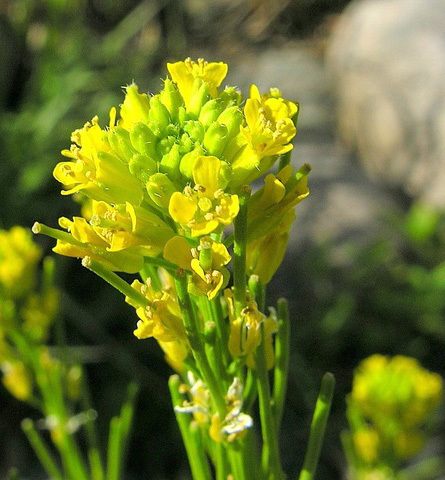
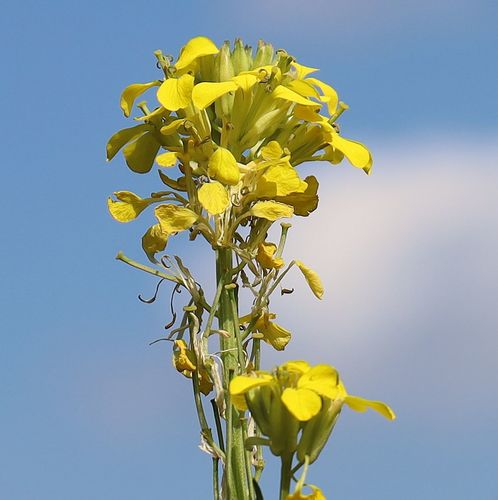
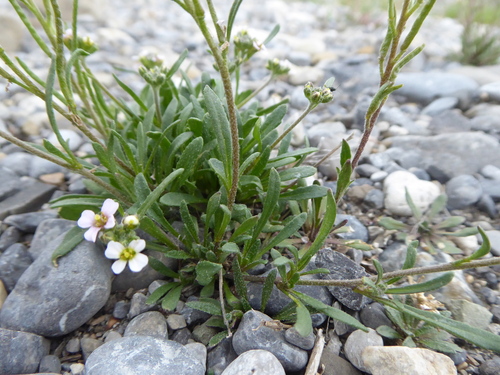
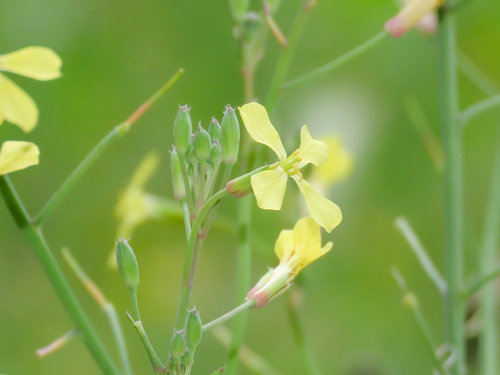
Raphanus raphanistrum subsp. rostratus (DC.) Thell., commonly known as wild radish, is an annual plant that grows up to 75 centimetres (30 in) tall. It is variously branched or multi-stemmed, with a distinct slender taproot that does not swell like the taproot of cultivated radish. Its stems are green, sometimes purple at the base and nodes, round in cross section, slightly ridged, and covered all over in bristly hairs. It produces a basal rosette of pinnate leaves that reach up to 38 cm (15 in) long, each with a 3-cm petiole (stalk) and a large rounded terminal lobe with an undulate margin; the lateral lobes sometimes overlap the leaf midrib. Stem leaves become progressively less lobed and more acutely serrated as they grow upward along the stem. Both the upper and lower surfaces of every leaf are roughly hairy, as are the leaf margins, which have minutely bulbous-based hairs that project horizontally. Each leaf tooth has a green or purple hydathode (tip). Its flowering period occurs between May and October in northern Europe, and between June and August in Minnesota. The inflorescence is a lax raceme, growing terminally or from a leaf axil, and reaches up to 34 cm long with up to 42 flowers. The flowers have four petals, which are usually white, sometimes yellow or purple, and grow up to 24 mm long; petals sometimes have dark veins, especially on their underside. Each petal has a rounded "limb" above a narrow "claw", with both parts approximately the same length. The four upright sepals are shorter than the petals, green or purple, and bear sparse bulbous-based hairs. There are 6 stamens (2 short and 4 long) and one style with two stigmas. The fruits grow on bristly-hairy pedicels about 3 cm long, and are held vertically regardless of whether the inflorescence rhachis is erect or sprawling. Each fruit is a pod divided into two segments: the lower segment is about 1-2 mm long and sterile, only occasionally producing a single seed, while the upper segment is up to 8 cm long and holds 1–10 fertile segments called mericarps, each containing one oval seed up to 3 mm long. A sterile beak up to 2.5 cm long sits at the tip of the pod. The fruits are terete, smooth or slightly ridged, and range from glabrous to roughly hairy, with a peppery taste. A persistent, sessile white stigma remains at the tip of the beak. This subspecies is native to temperate regions of North Africa, Europe, and parts of Western Asia. It is found in North Africa within Macaronesia, the Madeira Islands, the Canary Islands, Algeria, Egypt, Libya, Morocco, and Tunisia. Within Western Asia, it occurs in the Caucasus, Armenia, Azerbaijan, Cyprus, Georgia, Iran, Iraq, Israel, Jordan, Lebanon, Syria, and Turkey. In eastern Europe, it is found in Belarus, Moldova, and Ukraine. In middle Europe, it grows in Austria, Belgium, the Czech Republic, Germany, Hungary, the Netherlands, Poland, Slovakia, and Switzerland. In northern Europe, it occurs in Denmark, Estonia, Finland, Ireland, the Isle of Man, Latvia, Lithuania, Norway, Sweden, and the United Kingdom. In southeastern Europe, it is found in Albania, Bosnia and Herzegovina, Bulgaria, Croatia, Greece, Italy, Montenegro, North Macedonia, Romania, Serbia, and Slovenia. In southwestern Europe, it occurs in France, Portugal, and Spain. It is frost hardy, and even hard freezes only temporarily interrupt its blooming. In Australia, it is considered an invasive species that threatens native habitats across many areas. In Canada, it is a naturalised species that sometimes hybridizes with cultivated radish, R. sativus. It has also been found to be resistant to several herbicides. In southeastern USA, the pale yellow form of this plant is common, sometimes taking over entire winter fields. It is a significant source of pollen and nectar for a variety of pollinators, especially for honey bees during their very early spring population buildup. Female Andrena agilissima, or mining bees, frequently visit this plant to collect pollen and nectar. Other pollinators include cabbage butterflies and a few species of syrphid flies. All tender parts of the plant are edible. The leaves and flowers have a spicy taste or aftertaste. Seedpods can be eaten, as can the washed outer skin of the root. As early as 1753, John Walker reportedly cultivated the sea radish root as an alternative to horseradish after discovering the plant on the west coast of Scotland.