About Raoulia grandiflora Hook.fil.
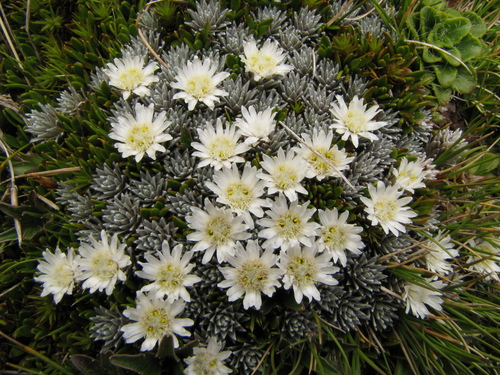
Raoulia grandiflora Hook.fil. is a small sessile flowering plant that bears white flowers. Its stems are woody at the base and heavily branched; branches and branchlets are arranged densely to rather loosely, and the plant forms cushions or mats up to approximately 15 centimeters in diameter, occasionally with a more open growth habit. Leaves are densely imbricate, measuring 5–10 × 1–2 millimeters, 3-nerved, and shaped ovate-lanceolate-spathulate, tapering to a subacute tip. The upper portion of both leaf surfaces is covered in appressed silvery tomentum, while tissue near the base is loosely tomentose. Capitula grow up to 1.5 centimeters in diameter; inner phyllaries are linear, contracted near the middle, obtuse, and have conspicuous white radiate tips up to approximately 5 millimeters long. There are 25–45 florets total: 8–15 are female florets with narrow slender corollas, and the remainder are perfect florets with funnelform corollas. The stylopodium is prominent. Achenes are less than 1 millimeter long and covered in silky hairs; pappus hairs are approximately 5 millimeters long, stiff, and slightly thickened at the tips. While some authorities classify this as only a South Island species, it can also be found in suitable habitat on the North Island, south of Mt. Hikurangi. This species occurs in subalpine or subarctic biomes. It is normally found in mountainous areas, growing among rocks, near scree fields, in tussock areas, and in gravel fields. This species often occurs in scree fields where tussock mats leave open growing space. It grows in plant communities with Anisotome aromatica, Celmisia laricifolia, and Cyathodes dealbata. In small water-collecting hollows with a sandy substrate, it grows in colluvium alongside Epilobium pernitens, Carpha alpina, Oreomyrrhis colensoi, and Viola cunninghamii. In tussockland it associates with Chionochloa crassiuscula and Celmisia haastii. It can also be found in gravel areas where rock makes up as much as 90% of the area. In gravel fields it is known to associate with Veronica pulvinaris, Anisotome imbricata, and Dracophyllum pronum.