About Raoulia eximia Hook.fil.
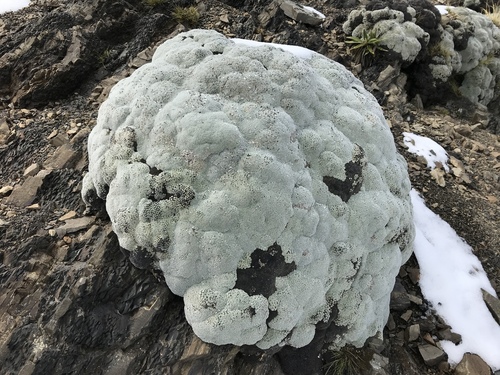
Raoulia eximia Hook.fil., commonly known as the Canterbury vegetable sheep, has a highly branched structure where only its unopened buds are visible from the outside. Small woolly leaves are arranged very tightly at the tips of the plant's twigs. Compressed internal structures create a dense, hard, convex growth form. Botanist Cockayne noted that this form makes "an excellent and appropriate seat for a wearied botanist".
This species forms round cushions that can reach 1 meter or more in diameter, and 5 decimeters or more in height. Its cushions are built from very closely packed woody branches attached to a strong main rootstock. Hook.f. described the species as a rigid plant that forms large woolly balls on mountains, covered in soft, velvety white tomentum. Its leaves are extremely densely compacted, entirely hidden among woolly hairs, and arranged in many overlapping series around the stems. They are 1/8 of an inch long, membranous, broadly linear or obovate-oblong, and rounded at the tip. A dense thick pencil of white velvety hairs grows on the back of each leaf above its middle; these bundles of hairs extend beyond the leaves and meet to cover the entire plant. The plant has grey to grey-green colouration and narrow buds. Its flower heads contain 10 to 15 or more florets. Its achenes are just under 1 millimeter long, covered in long silky hairs, with rigid pappus hairs.
Different Raoulia species can be easily confused, as they look very similar in overall appearance despite being taxonomically distinct. Raoulia eximia is most commonly found growing on rock outcrops. It occurs in subalpine to alpine rocky ground and fellfields, between latitude 41° and 45° 30' South. The light-coloured cushions of true vegetable sheep grow on drier fellfields east of the Southern Alps, between northern Otago and southern Nelson Marlborough, and from mid-Canterbury to northern Otago.
Raoulia is a notable exception among New Zealand alpine plant genera: around 93 percent of New Zealand's alpine plant species are found only in the New Zealand Biological Region, but most New Zealand alpine genera are minor members of the broader alpine flora, which is not true of Raoulia.
In the mountain habitats where this species grows, wind-blown material constantly forms new soil, but constant strong winds, cold summers, and frequent freeze-thaw cycles remove all accumulated soil. Alpine plants like R. eximia are exposed to high soil moisture except when the ground is frozen. Higher rainfall increases excess water, which makes the soil more acidic and causes nutrient leaching. R. eximia grows in raw soils with low nutrient concentrations, typically averaging 69.5 mg·kg-1 of total phosphorus and 0.04% of total nitrogen.