About Ranunculus lingua L.
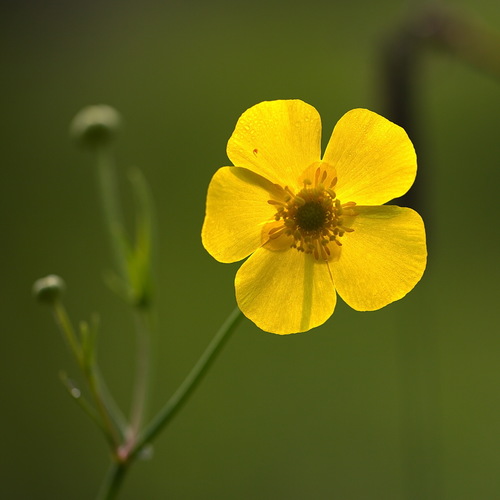
Greater spearwort, scientifically named Ranunculus lingua L., is a stoloniferous perennial plant. Its stems grow up to approximately 120 cm (47 in) long; they may start growing horizontally in mud, then become hollow and erect as they emerge from water. Aerial stems are sometimes branched, and often covered in a slight layer of short, eglandular, appressed hairs. Branches and the upper stem bear alternate leaves on short petioles; these leaves reach up to 30 cm (12 in) long and 3 cm (1.2 in) wide, with a narrow tip. In autumn, the plant produces shorter submerged basal leaves that typically overwinter. All leaves are generally glabrous and entire, though some may develop slight tooth-like edges near their apex. Flowering takes place during the summer months—June through September in northern Europe. The inflorescence is a cyme holding large 5-petaled yellow flowers (up to 5 cm across), each borne individually on a long pedicel. The flowers are hermaphroditic, with numerous stamens surrounding a glabrous receptacle that also holds many carpels. The fruits are obovoid achenes, up to 2.7 mm long, with a minutely pitted surface. The native range of greater spearwort extends across all of Europe and western Asia, reaching as far east as western Siberia and Xinjiang province of China. Globally, its populations are judged to be stable, and it holds a threat status of LC (Least Concern). Its status in Britain is somewhat more complex. As a native wild plant of various wetland types, it is thought to be declining, but it has been widely planted in garden ponds and wild areas since the 1950s. These introduced populations have more than compensated for native distribution losses, but may mask underlying environmental degradation. Even so, its overall status in Britain remains LC. Greater spearwort grows in a wide variety of wetland habitats, including marshes, ditches, ponds, canals, reservoirs, gravel pits and quarries. In the British National Vegetation Classification, it is recorded in six swamp vegetation types and one aquatic vegetation type; the aquatic type, A4, is rare and restricted to The Broads of East Anglia.