About Ranunculus lappaceus Sm.
Ranunculus lappaceus Sm., commonly called the common buttercup, Australian buttercup, or Yarrakalgamba, is found across eastern Australia. Like other buttercups, it is a perennial herb that produces yellow flowers in spring and summer. It was first described by James Edward Smith in 1815, and it retains its original scientific name. This species belongs to Ranunculus, the large, cosmopolitan genus of buttercups. Its species epithet lappaceus is Latin for "with burrs".
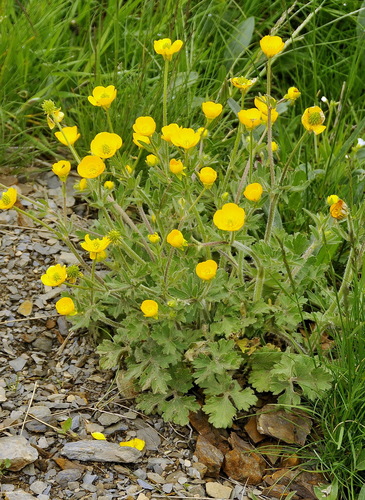
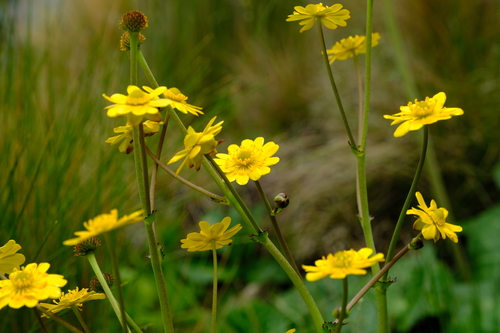
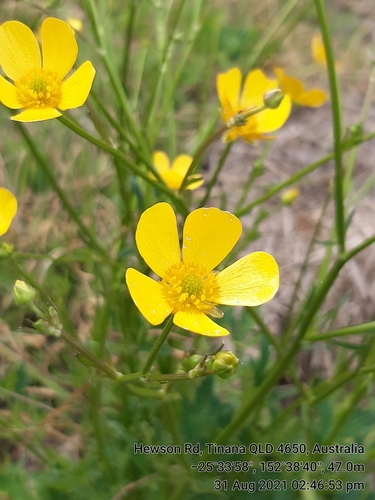
Ranunculus lappaceus grows as a perennial herb reaching up to 50 cm (20 in) in height. Its new growth is hairy. It produces yellow five-petaled flowers that can grow up to 4 cm (1.6 in) wide, which bloom in spring and summer. Its native range spans eastern Australia, covering Queensland, New South Wales, Victoria, South Australia, and Tasmania. In Western Australia, this species is replaced by the similar species Ranunculus colonorum, which has recurved sepals; R. colonorum has often been misidentified as R. lappaceus.
The main habitat of R. lappaceus is heavy, moisture-retentive soil. In the Sydney region, it grows on alluvial or clay-based soils formed from Wianamatta Shale or basalt in open forest, alongside tree species including mountain blue gum (Eucalyptus deanei), ribbon gum (Eucalyptus viminalis), forest red gum (Eucalyptus tereticornis), and prickly paperbark (Melaleuca styphelioides). This species occurs from sea level up to an altitude of 1,200 m (3,900 ft); in the Sydney Basin, the annual rainfall of areas where it grows ranges from 700–1,200 mm (28–47 in). A field study in Beaconsfield Upper found that R. lappaceus flowered 78 days earlier in 2006 than it did in 1983, a shift linked to climate change. R. lappaceus adapts easily to cultivation, growing well in acidic soils in full sun or part shade, and can be planted in rockeries or general garden bedding.