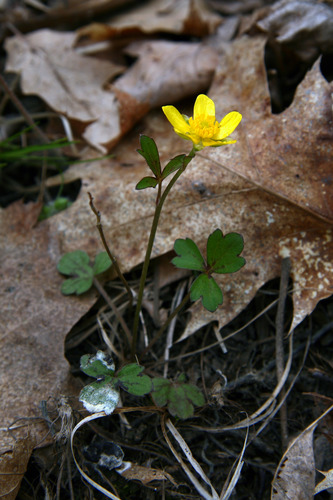
About Ranunculus hispidus Michx.
Ranunculus hispidus Michx. has upright stems that grow up to 30 cm (1 ft) tall, and tend to sprawl as the plant ages. Its stems are light green to pale reddish brown, covered in long spreading hairs. This species produces both basal leaves and alternate leaves growing along the stem. Basal leaves have long petioles, while stem leaves are smaller, with shorter petioles the higher they grow on the stem. Leaf form is variable; some leaves are compound with 3 leaflets, and some are wider than they are long. Each leaflet is coarsely toothed, often divided into 3 lobes, and can reach up to 10 cm (4 in) long. The flowers have 5 shiny yellow petals, measure roughly 2–3 cm (0.75–1 in) across, and grow individually on long hairy stalks. The hairy, lanceolate sepals are shorter than the petals. Flowering occurs from March to June. After flowering, the plant produces several flattened achenes that grow up to 3.5 mm (0.1 in) long. This species is native to North America. In the United States, its native range extends from Texas and North Dakota in the west, to the Canadian border in the north, to the east coast in the east, and to Florida in the south. In Canada, it is native to Quebec, Ontario, New Brunswick, Labrador, Manitoba, and Prince Edward Island. It grows in habitats including dry woods, ridges, slopes, and valleys. In its ecosystem, birds such as turkey and grouse, as well as small rodents, feed on its seeds. All parts of Ranunculus hispidus Michx. are mildly toxic if eaten, and may cause minor skin irritation on contact. Its foliage is poisonous to mammals such as cows, which avoid eating the plant.