About Ranunculus hederaceus L.
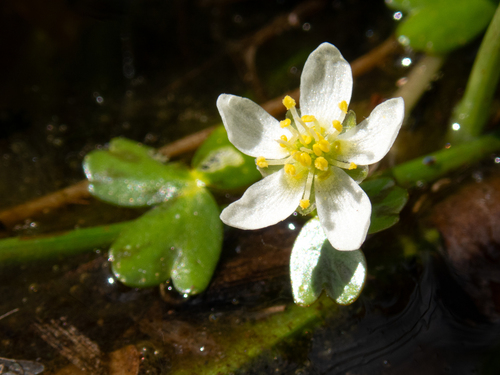
Ivy-leaved crowfoot, scientifically named Ranunculus hederaceus L., is a small creeping plant that can be annual or perennial. Its stems reach up to around 50 cm (20 in) long, and it produces only laminar leaves, with no submerged capillary leaves; leaves are arranged either opposite or alternate along the stem. The upper surface of the leaves is dark blueish-green, while the lower surface is paler. Leaves measure 2.5–3.5 cm (1.0–1.4 in) across, with 3–5 shallow lobes that are broadest at the base. Flowers grow singly on 1–2 cm (0.4–0.8 in) long pedicels that emerge opposite a leaf. Each flower has 5 narrow petals around 3 mm long, which are white with a yellow base and feature a crescent-shaped (lunate) nectar pit. The petals do not touch or overlap. It also has 5 green sepals that are nearly as long as the petals. Flowers are bisexual, with 9–43 carpels arranged on a hairy receptacle, plus numerous bright yellow stamens. In northern Europe, flowering occurs from March to August. Fruits are hairless, around 2 mm long, and sometimes have a narrow wing. This species can be distinguished from other water crowfoots by its lack of submerged capillary leaves, all leaves being shiny and ivy-shaped with 3–5 shallow lobes that are broadest at the base, and sometimes darker in the centre. Ivy-leaved crowfoot grows in mineral waters, while the similar-looking round-leaved crowfoot is always found in more peaty waters. This plant is most commonly found on bare muddy ground near water, where it carpets shallow water and drainage ditches. It often grows on the cattle-poached edges of ponds, ditches and streams, as well as in wet gateways and on paths and tracks. It may sometimes disappear entirely for one to two years during dry periods. It is characteristically found in contact zones between more elevated oligotrophic sandy soils and eutrophic (or polluted) small streams or small artificial running waters, or in stagnant waters strongly influenced by seepage. In Britain, its Ellenberg values are L = 7, F = 9, R = 5, N = 5, and S = 0, which indicate it favours wet, sunny locations with neutral to slightly acid, low-fertility soil, and avoids brackish environments. In the British National Vegetation Classification, it is associated with two aquatic communities: A13 alternate-leaved water-milfoil vegetation, typical of low-nutrient waterbodies in the north and west, and A8 yellow water-lily community, typical of lowland rivers, ditches and canals in the south. It is more common in water margin vegetation than open water, and has also been recorded in OV30 trifid bur-marigold, OV32 lesser spearwort and OV35 blinks communities, which occur on the margins of pools and lakes and in springs. In the United Kingdom, it is common in the wetter west of England, Wales and southern Scotland, and less common in eastern England and northwestern Scotland. In Ireland, it is common in the north and south, but scarcer in the centre. The UK is estimated to host at least 20% of the global population of ivy-leaved water-crowfoot. In Europe, its conservation status is Least Concern (LC), though the European Environment Agency considers it synonymous with R. hyperboreus, which has a wider distribution. It also holds LC status in Britain. This species is known to cause gastrointestinal distress, but it is also sometimes used to treat skin conditions and wounds, according to wildflowerweb.