About Ranunculus bulbosus L.
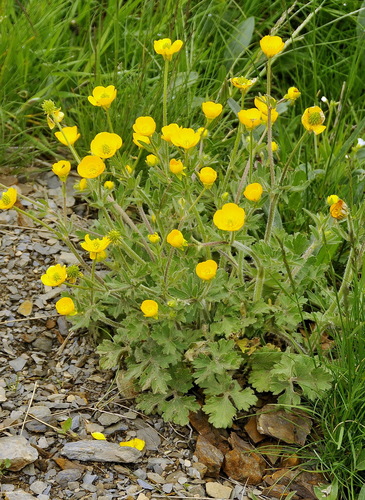
Ranunculus bulbosus L., commonly called bulbous buttercup, has erect, branching stems that are 20–40 cm (8–16 in) tall, slightly hairy, and have a swollen, corm-like base. Alternate, sessile leaves grow along the stems. Flowers form at the apex of the stems, with 5–7 petals and strongly reflexed sepals. The glossy yellow flowers measure 1.5–3 cm (0.6–1.2 in) wide, and the plant blooms from April to July. Its native range covers Western Europe, between approximately 60°N and the Northern Mediterranean coast. It has been introduced to North America, where it grows as a weed in both the eastern and western parts of the continent. Bulbous buttercup grows in lawns, pastures, and fields generally, and prefers nutrient-poor, well-drained soils. While it does not usually grow in established commercial crops or improved grassland, it is often found in hay fields and coastal grassland. Like other buttercups, this species contains the toxic glycoside ranunculin, which gives it a bitter, acidic taste. This makes human poisoning cases rare. Livestock also avoid the plant when it is fresh, but the toxin breaks down when the plant dries, so hay that includes bulbous buttercup is safe for animals to eat. Pigs are not affected by the toxin, and will readily eat bulbous buttercup, even traveling long distances to find it. This trait gave the plant its folk name St Antony's Turnip, after the patron saint of swineherds.