About Ranunculus acaulis Banks & Sol.
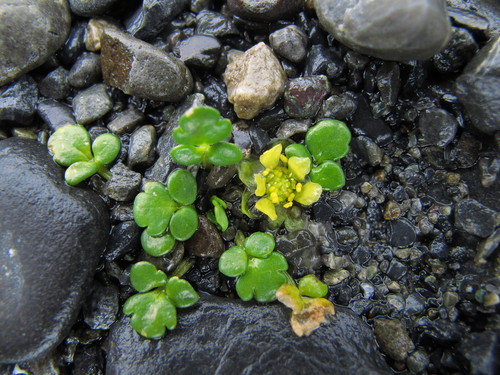
Commonly known as dune buttercup, Ranunculus acaulis Banks & Sol. is a small, hairless perennial herb. It grows in matted patches, formed by numerous plants that develop at the nodes of long, slender aerial shoots. Its leaves grow in a rosette, are 12–45 mm long, stalked, thick, shiny, and marked with many very small light dots. Leaf blades are three-lobed: the middle leaflet is either undivided or has three blunt teeth, while the lateral leaflets are undivided with a blunt tip, or bear one blunt tooth on their basal margin. Flowers are 7–10 mm in diameter, borne singly on stems that match the length of the leaves. It has three to five pale greenish or yellowish sepals, each around 1.5-2.5 mm long. It also has five to eight narrow yellow petals, each about 5 mm long, with a single pocket-like nectary located 1.5-2 mm from the petal base. Ten to twenty yellow stamens are arranged in roughly two circles around a raised green receptacle, which holds six to twelve yellow carpels. Its one-seeded dry fruits (called achenes) are beige when ripe, ovate in shape, and not flattened, with a somewhat curved beak up to 1 mm long. Ranunculus acaulis has 96 chromosomes (2n = 96). Dune buttercup is an indigenous species with the following distribution: in New Zealand, it grows on both main islands, Stewart Island, Chatham Island, and Auckland Island; in Australia, it occurs on the west and south coasts of Tasmania; in Chile, it is found in the provinces of Los Ríos, Los Lagos, Aysén, and Magallanes; it also grows on the Falkland Islands.