About Ranoidea caerulea (White, 1790)
Common Name & Size
Ranoidea caerulea, commonly known as the green tree frog, is a plump, relatively large tree frog that can reach a maximum length of 11.5 cm (4.5 in), with fully mature adult females slightly larger than males.
Facial Features
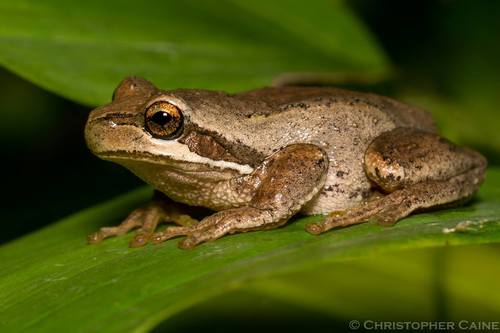
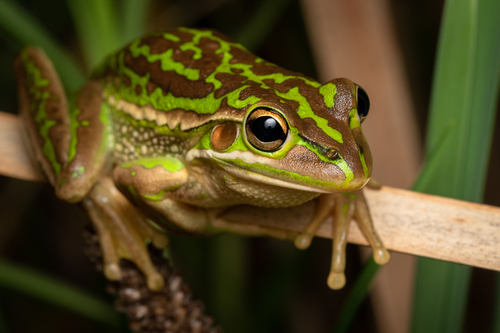
The species has a distinct fatty ridge above the eye, and a moderately large parotoid gland. Its iris is golden with a horizontally slit pupil, and the tympanum, a skin membrane analogous to an eardrum, is visible just behind the eye.
Limb Structure
Its limbs are short and robust, with large adhesive discs at the end of each digit that provide grip for climbing. The fingers are approximately one-third webbed, while the toes are nearly three-quarters webbed.
Dorsal Coloration
Dorsal body color changes with temperature and environmental conditions, ranging from brownish or greyish-green to bright emerald green. The back occasionally has small, irregularly shaped white spots.
Throat & Ventral Features
Males have a greyish, wrinkled vocal sac under the throat, while females have a white throat. The ventral (belly) surface of both sexes is creamy-white and rough in texture.
Similar Species: Magnificent Tree Frog
This species resembles the magnificent tree frog (R. splendida), which only lives in north-western Australia. Older magnificent tree frogs have very large parotoid glands that cover the entire top of the head and droop over the tympana. The green tree frog has a much smaller parotoid gland, and lacks the yellow back speckling and yellow markings on the hands, groin, and thighs that mark R. splendida.
Similar Species: White-Lipped Tree Frog
It can also be told apart from the white-lipped tree frog (giant tree frog, N. infrafrenatus), which has a distinct white stripe along the edge of the lower jaw that extends to the shoulder; this stripe is not present in the green tree frog.
Hydration Processes
As an arboreal hylid frog, Ranoidea caerulea (also cited under the synonym Litoria caerulea) uses two hygroscopically enabled hydration processes: transcutaneous uptake of condensation through its skin, and reduced evaporative water loss. Its wiping behavior spreads hygroscopic secretions from the parotoid gland across the skin, which enables both processes. The species' skin structure, hygroscopic coating, and favorable temperature gradient work together to increase condensation and moisture uptake.
Tadpole Development
Tadpoles of this species change appearance as they develop. Newly hatched tadpoles measure 8 mm (0.3 in) long, and reach 44 mm (1.7 in) when fully developed. They are initially mottled brown, and gain pigmentation, becoming either green or brown, as they grow. Their undersides start out dark, and lighten in color as development proceeds.
Egg Characteristics
The eggs are brown, wrapped in clear jelly, and measure 1.1 to 1.4 mm (0.043 to 0.055 in) in diameter.
Advertisement Call
The advertisement call of the green tree frog is a low, slow brawk-brawk-brawk, repeated many times. For most of the year, green tree frogs call from high positions such as trees and gutters, but during the breeding season they move down to be near ponds and pools, where breeding takes place.
Calling Behavior
Like many frog species, green tree frogs call not only to attract mates, but also to advertise their location outside of the mating season. They are especially vocal after rain, though the reasons for this behavior are not currently clear.
Stress Call
They produce a distinct stress call when in danger, such as when attacked by a predator, or when a person steps on a log where one is hiding.
Native Range
The green tree frog is native to northern and eastern Australia and the lowlands of New Guinea. Its distribution is mostly restricted to areas with warm, wet tropical climates.
New Guinea Distribution
In New Guinea and Indonesia, its range runs from Irian Jaya to Port Moresby, and it is most abundant on Daru Island, with the IUCN noting that populations are found in scattered locations across both New Guinea and Indonesia.
Australian Distribution
In Australia, its range extends from the Kimberley region of Western Australia, through the Northern Territory and Queensland, to northern and central New South Wales and the extreme northeastern part of South Australia. Its total extent of occurrence is approximately 4,078,600 square kilometres (1,574,800 sq mi).
Introduced Range: United States
The species has been introduced to the United States and New Zealand. In the United States, it is found only in two regions within Florida, and was likely introduced via the pet trade. Only small populations have been recorded there, and it is unknown whether the species causes ecological damage as an invasive species.
Introduced Range: New Zealand
In New Zealand, several individuals were released at various locations in 1897 and 1899, with an additional accidental introduction in the 1940s; no sightings of the species have been reported there since the 1950s.
General Habitat Preferences
Green tree frogs occupy a variety of habitats depending on their location. They prefer moist forests, but are not restricted exclusively to tropical rainforests. They are often found in tree canopies near water bodies, but also live in terrestrial habitats far from water.
Specific Habitat Types
They favor mature stands of Eucalyptus, where tree hollows hold collected water. They are common along inland waterways, and can survive in swamps among reeds, or in grasslands in cooler climates.
Human-Associated Habitats
Green tree frogs are tolerant of human presence and often live in close association with people. They sometimes enter houses, and can be found in areas such as sinks and toilets. They may also be found on outdoor windowsills at night, eating insects drawn to the light, and may gather under outdoor lighting for the same reason.
Artificial Water Habitat Use
They often occupy cisterns, downspouts, and gutters, since these areas have high humidity and are typically cooler than the external environment. During the mating season, they may be attracted to these structures because they amplify the frogs' calls.
Homing Ability
Green tree frogs appear to have homing abilities, and can return to their original location from a significant distance after being displaced.
Temperament & Activity Cycle
Australian green tree frogs are very docile and unafraid of humans. They are nocturnal, and emerge in the early evening to call (during spring and summer) and hunt for food. During the day, they rest in cool, dark, moist spots such as tree holes or rock crevices.
Moisture Regulation
While they are not exclusively a rainforest species, they use daily rainfall that collects on leaves and in crevices to keep their skin moist. Their skin secretes a waxy coating that helps prevent water evaporation. During dry periods, they avoid desiccation by hiding in a cool location, sometimes by burrowing, and wrapping themselves in a cocoon made of shed skin and mucus.
Diet Composition
The diet of the green tree frog consists mostly of insects such as moths, cockroaches, and locusts. They also eat spiders, and can prey on smaller frogs and even small mammals including bats. Frog teeth are not adapted to cutting up prey, so prey items must be small enough to fit whole into the frog's mouth.
Feeding Behavior
Most frogs flip their sticky tongue out at prey, which sticks to the tongue tip and is pulled back into the mouth to be eaten. Green tree frogs use this technique for smaller prey; for larger prey items, they pounce, then push the prey into their mouth using their hands.
Predators
Native predators of the green tree frog include snakes and birds. After European settlement of Australia, non-native predators including primarily dogs and cats were introduced.
Life Expectancy
The species has an average life expectancy of 16 years in captivity, and some individuals have been recorded living over 20 years.
Breeding Behavior
Breeding occurs between November and February. During the mating season, males call from slightly elevated positions near the still-water sites where they breed. Females lay egg clumps containing between 200 and 2000 eggs; the eggs initially float, but sink within 24 hours.
Tadpole Metamorphosis
Tadpole development takes approximately six weeks, after which tadpoles undergo metamorphosis and leave the water as juvenile frogs.
Skin Respiration & Pathogen Risk
Although frogs have lungs, they also absorb oxygen through their skin, which requires the skin to stay moist to work efficiently. A drawback of moist skin is that pathogens such as molds and bacteria can grow on it, increasing infection risk. To counter this, frogs secrete peptides that kill these pathogens.
Antibacterial Secretions
Secretions from the parotoid gland of the green tree frog contain 25 caerins, a group of peptides with antibacterial and antiviral properties. Caerins produced by green tree frogs from different geographic locations have small but consistent differences.
Caerulein Properties
The secretions also contain caeruleins, which have the same physiological effects as CCK-8, a digestive hormone and hunger suppressant. These caeruleins are currently used in a number of clinical applications.
Anti-HIV Peptides
Several peptides from the green tree frog's skin secretions have been found to destroy HIV without damaging healthy T cells.
Chytridiomycosis Resistance
The fungus Batrachochytrium dendrobatidis, which causes the disease chytridiomycosis, is driving population declines in many amphibian species, but secretions produced by the green tree frog and certain other Australian frog species (Litoria chloris and Litoria genimaculata) protect against this fungus. The peptides inhibit fungal growth in vitro, and green tree frog populations are not believed to be in decline.
Scientific Research Use
Green tree frogs are sometimes used as model organisms in scientific research. The structure of their toe pads has been used to study the microstructure and properties of the epithelium that allows these frogs to adhere to wet surfaces.