About Rana pyrenaica Serra-Cobo, 1993
Taxonomic Identification
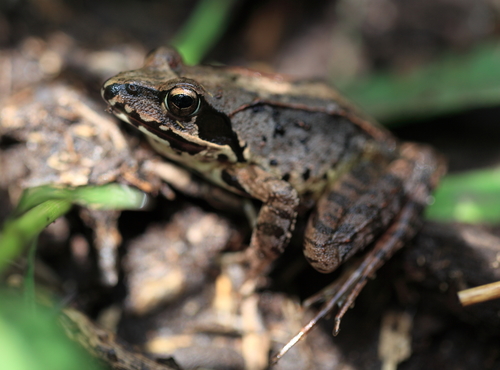
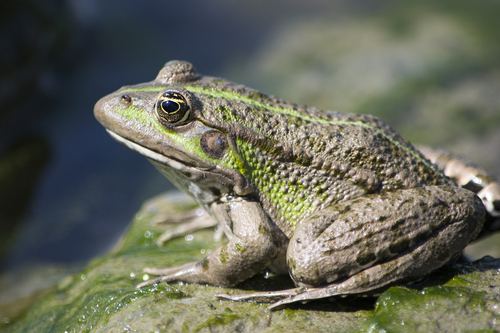
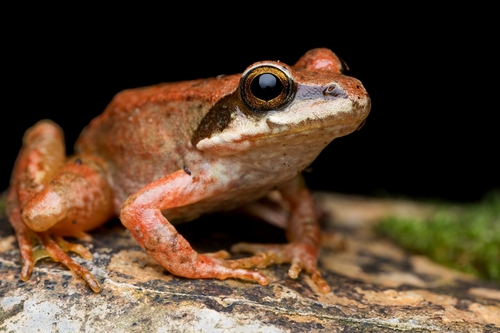
The Pyrenean frog (Rana pyrenaica Serra-Cobo, 1993) is the smallest species of brown frog native to Europe.
Size
Adult individuals reach a snout-to-vent length of approximately 33 to 45 millimeters (1.3 to 1.8 inches), and females are slightly larger than males.
Head and Snout Morphology
This species has a blunt, rounded snout, and the nostrils are more widely spaced than the bulges of the eyes.
Tympani and Folds
The tympani are small and not always visible, and the dorso-lateral folds are positioned fairly close together.
Hind Foot Structure
The hind feet are fully webbed except for the tip of the fourth toe.
Dorsal Coloration
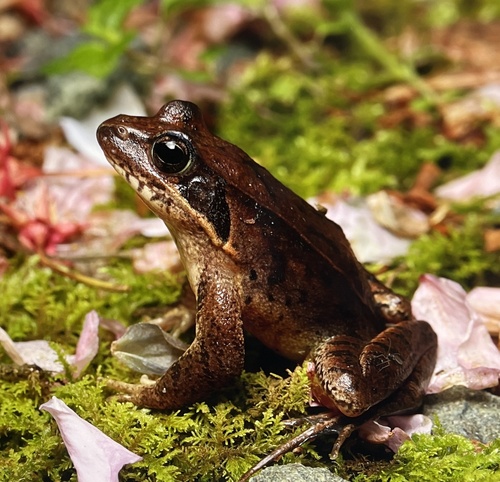
The frog's base coloration ranges from creamy-brown, buff, greyish-brown, and reddish-brown to olive-grey, with rather indistinct blotches of greenish-brown or brown.
Leg and Lip Markings
The hind legs have faint barring, the upper lip is often noticeably pale, and the throat and underparts are whitish.
Ventral Coloration
The belly is sometimes flushed with yellow or pink, especially under the thighs.
Species Distinction
It can be distinguished from the common frog (Rana temporaria) by its smaller size, less pointed snout, and less distinct markings.
Endemic Range Altitude
The Pyrenean frog is endemic to the Pyrenees mountain range, with most populations located on the Spanish slopes at altitudes between roughly 1,000 and 1,800 meters (3,300 and 5,900 feet).
Spanish Distribution
Its range stretches from Ordesa y Monte Perdido National Park to Roncal Valley in the Navarre region.
French Distribution
Small populations also exist on the French side of the mountains.
Preferred Habitat
This frog inhabits fast-moving, rocky streams with little vegetation and the surrounding areas, and shares this habitat with the Pyrenean brook salamander (Calotriton asper).
Avoided Habitats
It avoids still water bodies such as ponds and lakes.