About Ramphocelus sanguinolentus (R.Lesson, 1831)
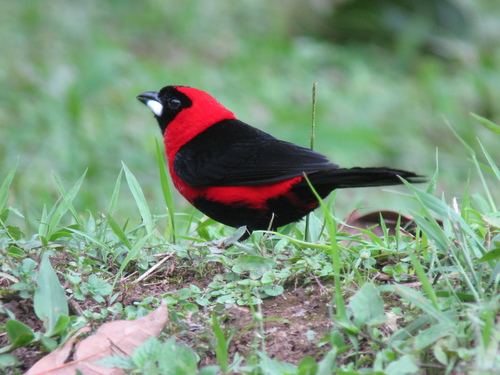
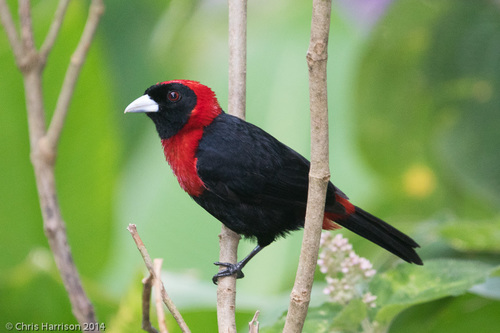
Description: Crimson-collared tanagers (Ramphocelus sanguinolentus) average 19–20 cm (7.5–8 in) in length. Adult plumage is primarily black, with a red collar that covers the nape, neck, and breast — a pattern that is remarkably similar to that of the male crimson-collared grosbeak. All tail coverts are also red. Adults have a distinctive pale blue bill, blue-gray legs, and crimson irides, which is not what is depicted in the work by Howell and Webb. Females are on average slightly duller in coloration than males, but the two sexes are sometimes indistinguishable from one another. Juvenile birds have a similar overall appearance, differing in that their hood is dull red, their black plumage areas have a brown tinge, and their breast is mottled red and black. Young birds also have a duller bill color than adults. The species' vocalizations are high-pitched and sibilant. It produces several distinct calls; one call, transcribed as ssii-p, is given both when the bird is perched and when it is in flight. Its song is jerky, made up of two-to-four-note phrases separated by pauses, with common transcriptions including tueee-teew, chu-chee-wee-chu, and teweee. Distribution and habitat: The crimson-collared tanager's range extends from southern Veracruz and northern Oaxaca in Mexico, along the Atlantic slope of Central America, to the highlands of western Panama. It lives at the edges of humid evergreen forests and in second growth, where it is most often observed in pairs at middle to upper vegetation levels.